
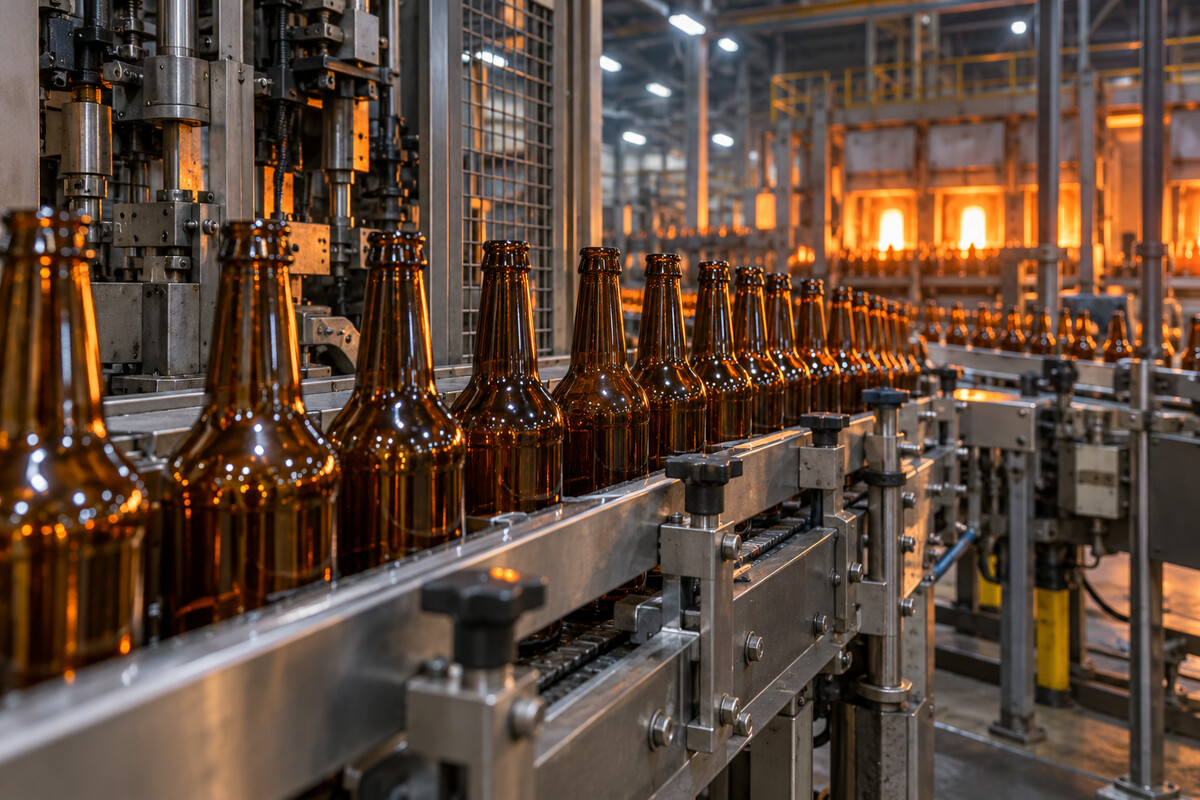
Penrith changes its melting equipment
Visy commissioned a $150 million glass furnace at Penrith in Western Sydney on 18 July 2024. The investment combines oxygen combustion with recycled-glass preheating at a site making bottles and jars for food and beverage customers. Visy said the replacement furnace used less than half the energy of its predecessor. That comparison concerns the equipment it replaced at Penrith; the company also described the installation as Australia's most energy-efficient glass furnace.
The Penrith factory produces more than 800 million glass containers annually, using recovered glass from household recycling bins and the Return and Earn container deposit scheme. That annual figure covers the site's production. The new furnace and cullet-preheating equipment form part of Visy's programme to raise average recycled content in its bottles and jars across Australia and New Zealand to 70%.
Oxygen combustion and flame control
Oxyfuel combustion replaces ordinary combustion air with oxygen. Oxygen supports combustion; it is not the fuel. The change removes the nitrogen that ordinarily dilutes and cools the flame. Industrial-gas company Linde explains that the resulting flame is hotter and more concentrated, allowing less fuel to be used. Controlling its shape and heat distribution remains part of the engineering task: the furnace needs the intensity of oxygen combustion together with the uniformity required for glass production.
Burner designs also address conditions around the melting surface and furnace structure. Linde's glassmaking technologies include wide, low-momentum flames intended to reduce particulate emissions and crown corrosion, along with designs developed to address condensate around burner ports and foam on the glass surface. These are examples of the technical work involved in controlling oxygen combustion. Linde estimates that melting accounts for more than 80% of glass-production energy. Its separate waste-heat recovery technology uses endothermic chemical reactions and, according to the supplier, can reduce energy consumption by up to 30%. Linde also develops oxygen supply systems for the glass industry, including on-site production using vacuum pressure swing adsorption, alongside its burner and waste-heat recovery technologies.
Sorting smaller glass fragments in Victoria
Visy's Laverton recycling factory in Melbourne received a $50 million upgrade unveiled on 15 February 2024. The modernised facility has capacity to recycle up to 200,000 tonnes of glass a year, doubling the company's glass-recycling capability in Victoria. Recovered material is destined for Visy's Spotswood factory, which remanufactures it into bottles, jars and other glass containers. Spotswood houses Victoria's only glass-container furnace.
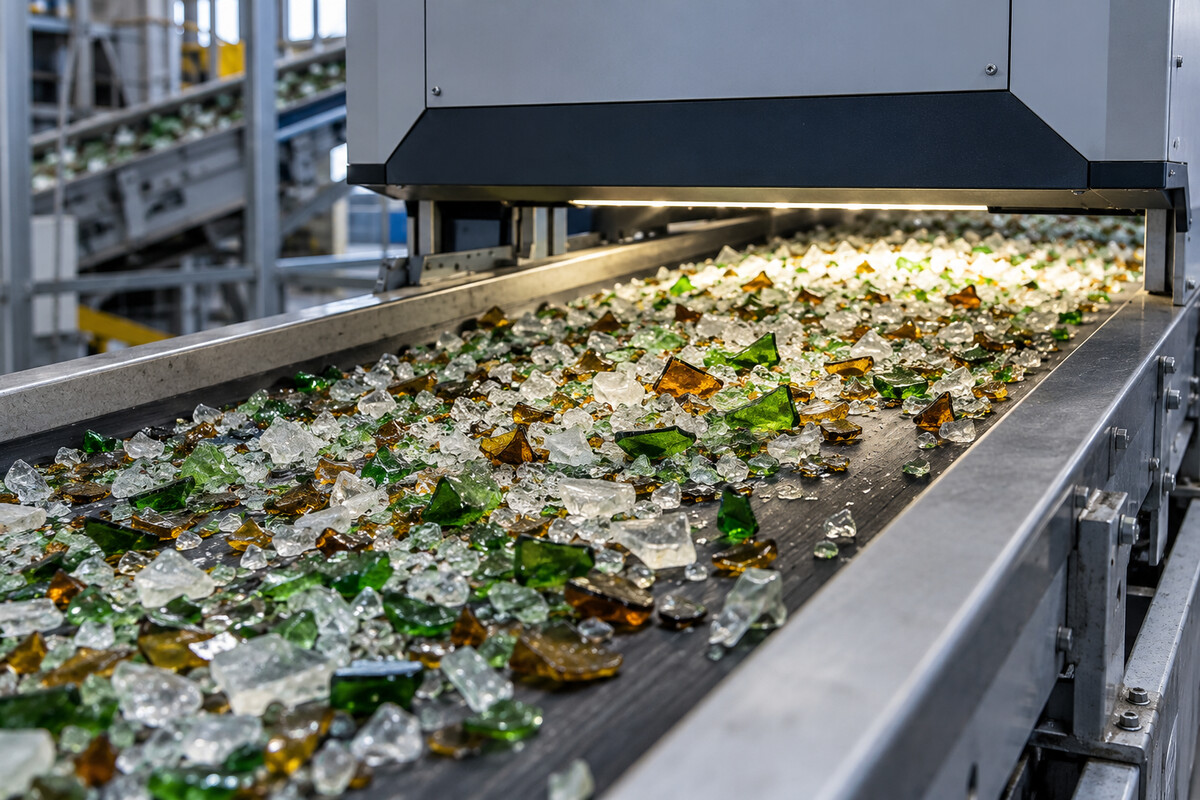
Twenty new optical cameras allow Laverton to sort fragments down to three millimetres, compared with the previous facility's minimum of ten millimetres. Smaller pieces can therefore enter the sorting process. Visy linked the investment to its recycled-content programme and said a container made with 70% recycled content could be up to 30% less greenhouse-gas intensive than one containing no recycled glass. This is the company's comparison between those two container compositions, rather than a measured reduction for every product passing through the upgraded facility.
Inside a materials recovery facility
Materials recovery involves several sorting methods. Visy's free virtual recycling-facility tour, launched on 17 March 2025, shows manual, mechanical and optical sorting, as well as magnets and eddy currents used across the material streams. The tour follows sorted materials through to their remanufacture into new products. Individuals, schools, families and community groups can use the online resource to explore equipment that is usually inside an operating recycling facility. Visy's educational aim is to help households understand recycling and reduce contamination in collected material.
Counting containers and measuring tonnes
New South Wales container-deposit statistics use both container counts and material weights. The NSW Environment Protection Authority's data-quality guidance, updated on 16 April 2026, explains that the network operator supplies figures for each local government area and material type. A conversion factor translates container numbers into tonnes, and the conversion method is updated every six months. The EPA's network figure covers containers collected through reverse vending machines, reverse vending centres, automated depots, over-the-counter sites and donation stations. The Return and Earn annual report has a broader tonnage boundary: it includes network collections and eligible containers processed by materials recovery facilities on the scheme's behalf. A network-only total and that combined total consequently cover different collection routes. Both the coverage of the collection system and the count-to-weight conversion belong with the figures when comparing quantities of recovered containers.
Return and Earn's collection routes
Return and Earn began in December 2017 with a ten-cent refund for eligible drink containers. During 2023–24, the scheme had 633 network-operator collection points across New South Wales, and 84% of adults in the state had participated. Between its launch and June 2024, collections reached 15.2 billion containers, including 3.4 billion collected through kerbside recycling. More than 1.08 million tonnes of material had been recycled across the scheme's eligible container materials.

Eligible drink containers accounted for 38.6% of the volume of litter in New South Wales in 2022–23 and 4.6% of littered items. The volume of litter from eligible containers had fallen by 71% since the scheme began. Glass collected through the scheme also had a recorded processing destination. In 2023–24, 88% went to recycling facilities within New South Wales; the balance went to Queensland and South Australia. That percentage describes where the collected glass was sent. It does not measure the recycled content of a new bottle, or the proportion delivered to Penrith. The collection totals likewise combine eligible container materials rather than measuring glass alone.
Glass within national packaging flows
Australia placed an estimated 6.98 million tonnes of packaging on the market in 2021–22, with glass accounting for 16.4% of that tonnage. Across all packaging materials, post-consumer recovery reached 3.91 million tonnes, or 56%; glass represented 18.4% of the recovered packaging stream. These national figures, released by the Australian Packaging Covenant Organisation on 29 April 2024, measure different flows: packaging entering the market and packaging recovered after use. Glass's share of the recovered stream is therefore not its recovery rate. APCO also classified all glass packaging as having good recycling potential, a classification distinct from the quantity actually collected and recovered. Across packaging materials, 84% of tonnage had good recycling potential. Post-consumer recycled content totalled 2.57 million tonnes, equivalent to 40% of packaging, against the national target of 50%. APCO considered the voluntary 2025 targets unattainable within their timeframe and called for cooperation across packaging businesses, governments and the waste and recycling sectors. Its work included strengthening collection, sorting and reprocessing capacity.
Post-consumer content reaches 54%
Glass packaging's national post-consumer recycled content increased from 50% in 2022–23 to 54% in 2023–24. Glass became the first packaging material to meet its material-specific National Packaging Target for recycled content, and met that target for a second consecutive year. APCO released the 2023–24 results on 1 December 2025. The 54% figure measures post-consumer material within glass packaging placed on the Australian market.

Reported domestic glass-reprocessing capacity also exceeded glass packaging placed on the market in 2023–24, the first time that had occurred since reporting began in 2018–19. Capacity concerns the quantity the processing system can handle; it is separate from the recycled content incorporated into new packaging. Across all packaging materials, domestic reprocessing capacity reached an estimated 52% of packaging placed on the market, compared with 49% in 2022–23 and 31% in 2018–19. These system-wide capacity percentages cover a broader material mix than glass alone. The national recycled-content measure covers Australian packaging, while Visy's company figures have their own geographical and reporting-period boundaries.
Visy's company and product averages
Visy's bottles and jars across Australia and New Zealand contained an average of 63% recycled glass in the financial year to date when the company announced its milestone on 9 April 2024. Amber and green glass packaging had a higher average, at 75% over the same period. Some green and amber bottles contained up to 90% recycled glass. The three figures describe the company-wide average, the coloured-glass average and selected products respectively.
Visy was still working towards a 70% average across its bottles and jars in the two countries. Its April update connected that work with the Laverton investment and projects in New South Wales and Queensland. The company also attributed lower energy requirements to recycled content: a Visy container with 70% recycled content could use up to 30% less energy to manufacture than a container with none. The comparison concerns energy, distinct from the greenhouse-gas comparison attached to the Laverton announcement.

New Zealand achieves the company target
Visy achieved an average of 70% recycled content in its locally manufactured bottles and jars in New Zealand, announcing the milestone on 16 April 2025. New Zealand was the first country in its operations to reach that benchmark. The company's Auckland factory remanufactures glass collected from 50 councils, supplying wineries and other food and beverage businesses. Annual production in the country exceeds 700 million glass bottles and jars.
The company had been working towards the target since 2021. It credited the practice of separating glass by colour at the kerb with supporting higher recovery and helping it reach the recycled-content average. The Auckland milestone applies to locally made New Zealand packaging. It is geographically distinct from the earlier financial-year-to-date average across both countries and from the Australian national packaging statistics.
Planned recovery infrastructure at Stapylton
Visy entered a memorandum of understanding with Advanced Resource Recovery Centre Gold Coast and the City of Gold Coast on 14 November 2025 to advance a materials recovery facility within the ARRC Precinct at Stapylton. The planned facility would sit alongside the new Yatala glass recycling and remanufacturing hub. The partnership also included collaboration on a feasibility study into hard-plastics processing and recycling in the precinct. Visy expected the partnership to expand its recycling capacity, support local manufacturing and create jobs. Those were anticipated benefits of the proposed development. The agreement concerned development of recovery infrastructure; it was not an announcement that the materials recovery facility had opened.
Recruiting the Yatala operating team
More than 100 jobs were open at Yatala when Visy began the next stage of recruitment on 8 September 2025. The vacancies covered operators, technicians and trades, with hiring also extending to shift managers. Previous experience in glass manufacturing was not required. Visy offered training for new starters and opportunities to work with industrial systems at the new recycling and manufacturing facility.
The recruitment announcement forecast that the factory would be operational in 2026. The site adjoins existing Visy cardboard-box, beverage-can and food-can factories, with customers including Asahi Beverages, Lion, Bundaberg and Coca-Cola. Its planned manufacturing processes included oxygen combustion and recycled-glass preheating. The vacancies were positions being advertised during the build-up of the operating team, rather than a count of jobs already filled or evidence that commercial glass production had started.
Training before production starts
Seven cohorts of maintenance and operations employees were undertaking a purpose-built training programme by 20 April 2026, while construction continued at Yatala. Four further cohorts were scheduled to begin from May. The programme runs for ten to sixteen weeks, including two weeks of structured onboarding, and combines practical instruction with hands-on learning for glass-packaging work.
- Classroom sessions and online learning form part of the programme.
- Virtual reality provides another training method.
- On-the-job training takes place at Visy's existing South Brisbane glass site.

Employees were therefore learning through several formats and at an existing operating location while preparing for roles at the new factory. Dedicated trainers supported the incoming team. The April training update concerned preparation for maintenance and operations work; the new site's construction was still underway.
Yatala's construction milestones
The $500 million Yatala project at Stapylton includes recycling, manufacturing, storage and distribution infrastructure. Its planned annual capacity is up to 200,000 tonnes of recycled glass and one billion bottles. Optical sorters are designed to process glass down to three millimetres before remanufacture in the furnaces. Visy expected local recycling to avoid trucking 40,000 tonnes of glass into Queensland. A finished-goods warehouse and distribution centre are included to support container supply to customers. A long-term partnership with Asahi Beverages underpins the expansion. Visy forecast more than 600 construction jobs and 200 jobs once the site became operational.
Frames for two furnaces were installed by 24 June 2025, followed by foundations and structural steel for the furnaces and batch building by 25 July. A 12 March 2026 update recorded the reuse of 50,000 cubic metres of hard rock as a base for about one kilometre of site road. By 7 October 2026, construction was nearing completion and the company was getting close to making the first bottle. At that checkpoint, the stated annual recycling and bottle volumes remained planned capacities.
Leave a comment