
A supply agreement for container-ship fuel systems
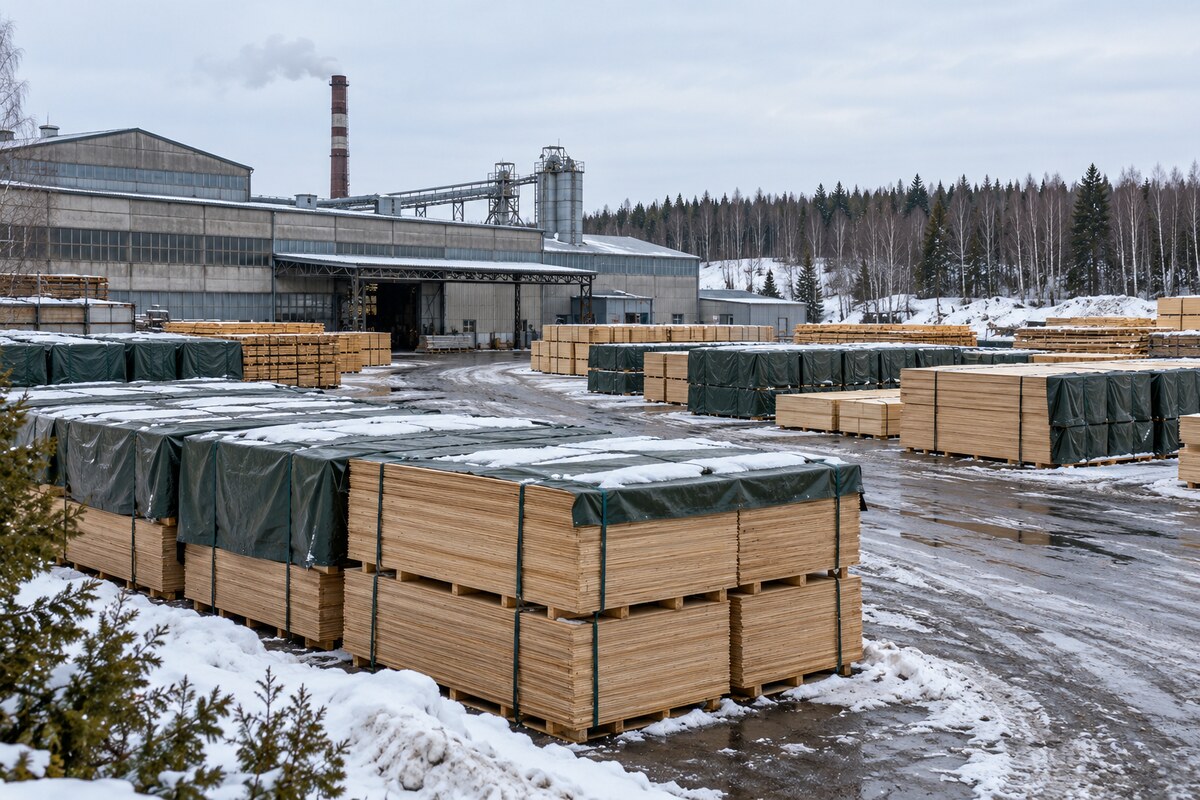
Segezha Group plans to supply LNG-grade plywood to an East Asian partner in 2026 under a signed agreement. The material is intended for fuel systems aboard seven LNG-fuelled container ships. Chief executive Kirill Arsentyev announced the arrangement; the buyer, destination country and shipment volume remained undisclosed. Segezha estimated annual global shipbuilding demand for LNG plywood at tens of thousands of cubic metres.
Vyatsky Plywood Mill in Russia manufactures Segezha’s tanker plywood. Its design capacity after full ramp-up is 192,000 cubic metres annually across its plywood products. The mill produced more than 180,000 cubic metres in 2024. Those totals concern the mill’s wider assortment, rather than LNG-grade material alone. Segezha had not published its 2025 operating results by the March announcement.
The earlier visit by Samsung Heavy Industries
Representatives of Samsung Heavy Industries visited the Vyatsky mill in Kirov before the new agreement. On 14 May 2025, Segezha announced plans for a long-term contract and initial supplies before the end of that year. The visiting shipbuilder’s team examined the Segezha-LNG manufacturing technology and the production sequence from incoming raw material to dispatch. The discussions concerned use of the product in South Korea’s shipbuilding sector. The identified company in that earlier visit remains distinct from the unnamed partner in the March 2026 arrangement.

A manufacturing execution system, or MES, provided automatic monitoring and recording of veneer and plywood volumes and quality indicators throughout production. Segezha highlighted that system during the visit. Commercial vice-president Dmitry Beresnev associated the proposed cooperation with the mill’s production capabilities and the product’s existing international certificates. Segezha then anticipated at least 25% higher special-product output from those agreements. The mill also manufactured plywood for passenger and freight transport, construction, interior applications and furniture. Its marine product belonged within that broader manufacturing operation.
Qualification for particular containment technologies
Segezha’s LNG plywood already had a qualification history before those commercial discussions. In September 2023, the company identified certificates obtained in 2022 for plywood used in membrane insulation-panel elements. The named technologies were GTT’s NO96, NO96 L03 and L03+, Mark III, GST and NO96 Super+. The certificates concerned the material’s application in specified panel technologies for LNG transport and storage reservoirs. They were not described as certificates for complete ships.
Beresnev, then vice-president and head of the Plywood and Boards division, said the product was being supplied for export and that Segezha was ready to participate in domestic shipbuilding. Most shipments at that stage went to China, while shipyards and membrane-insulation manufacturers elsewhere in Southeast Asia were showing interest. Vyatsky Plywood Mill in Kirov Region was the manufacturing site. GTT, or Gaztransport & Technigaz, was the engineering company associated with the listed containment technologies.

Commercial shipments and distribution work in 2022
Segezha made its first shipments under a new LNG-plywood business direction in 2022. The applications included shipbuilding for LNG transportation and construction of land-based LNG storage terminals. The company also concluded a long-term contract for plywood used in building LNG tankers in China. These were commercial developments recorded for that year, separate from the later statements about domestic shipbuilding readiness and the subsequent negotiations with another named shipbuilder.
The company’s distribution work during 2022 included container routes through Novorossiysk and Far Eastern ports, rail deliveries to China and multimodal arrangements involving transshipment. Its plans for 2023 included expanding the geography of sales and customer base and developing direct industrial business. Automotive manufacturing, shipbuilding and machinery were among the industrial applications identified. Expansion of tanker-plywood sales was also part of the following year’s programme. The proposed changes covered customers and distribution as well as the wider plywood assortment, retaining their status as plans for that period.
From a veneer log to a finished panel
Segezha’s general plywood manufacturing sequence starts with receiving and storing logs, followed by debarking, cutting and hydrothermal preparation. Rotary peeling produces a continuous veneer sheet, which is clipped and stacked. Drying precedes sorting by quality and separating material for face and inner layers. Edge joining combines narrower veneer strips into full-sized sheets for internal layers. Defects such as knots can be removed and replaced with sound veneer patches before further sorting and assembly.
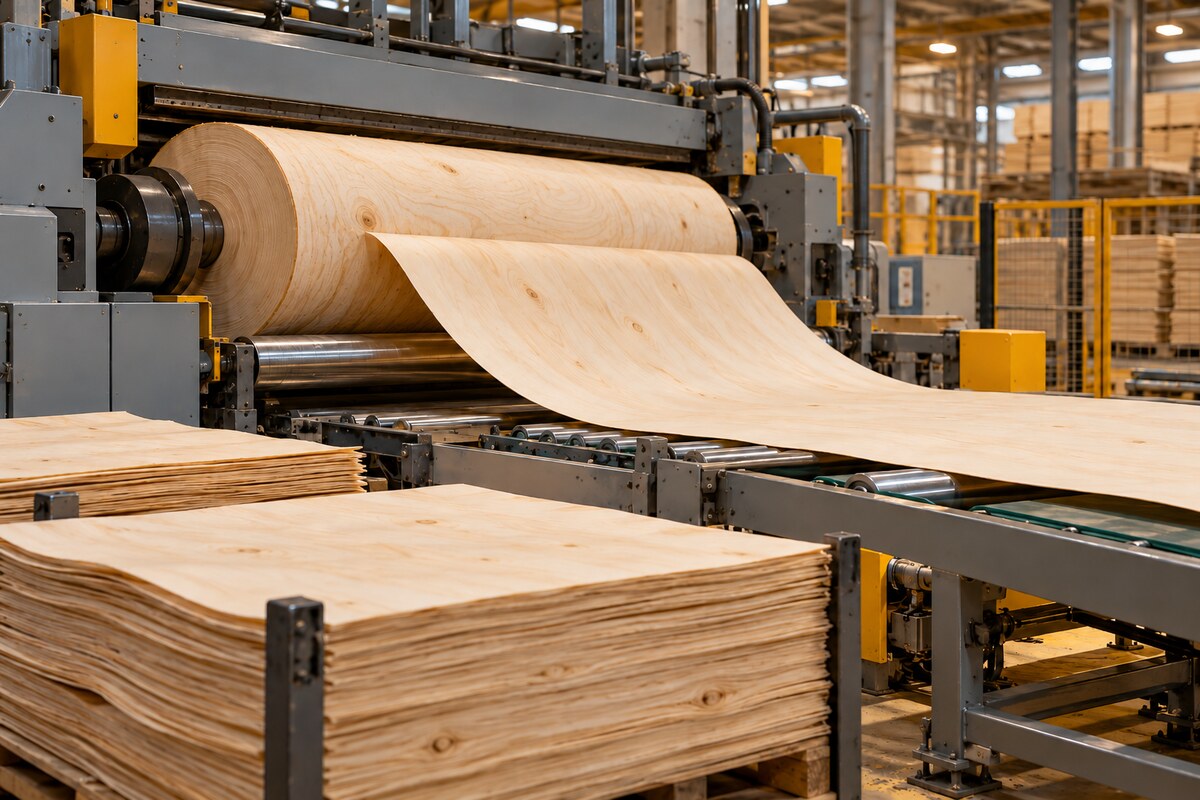
The subsequent stages bring the veneers together:
- Adhesive preparation and application accompany the selection of veneer sheets.
- Lay-up alternates the grain directions of neighbouring layers.
- Cold pre-pressing consolidates the assembled package before hot pressing bonds the panel.
- Trimming, repair and sanding prepare the panel for the relevant finish.
- Lamination, edge treatment, grading, packaging and storage appear among the finishing stages.
Segezha’s wider plywood assortment includes different finishes and applications, including sanded and laminated products. The stages above form its general manufacturing sequence across that assortment.
A different producer’s Mark III testing stage
Sveza’s qualification work provides another dated example from Russian plywood manufacturing. On 6 March 2019, the company announced that its plywood had passed tests for the Mark III system, while the product approval certificate was still expected. The proposed certificate would cover thicknesses from 9 to 92 millimetres. Sveza already had certification and production under the NO96 and NO96-L03 and L03+ systems. Passing the announced tests and receiving the anticipated certificate were separate steps in that update.

The Mark III product used selected birch veneer. Sveza specified cryogenic use at approximately −160°C for its own gas-plywood product. Launch preparations included investment in equipment and testing, with two groups of tests undertaken at a specialist laboratory in France. Sveza linked the new qualification to prospective cooperation with Samsung Heavy Industries, Daewoo Shipbuilding & Marine Engineering, Hyundai Heavy Industries and Hudong-Zhonghua. Those were the manufacturer’s commercial intentions at the time. Sveza’s qualification programme and named prospective customers belonged to its own commercial plans in 2019.
Wooden insulation boxes and metal membranes
Containment architectures give the materials different roles. In GTT’s February 2017 presentation, the NO96 Max design combined primary and secondary Invar membranes with two insulation-box layers made from plywood and glass wool. The illustrated assembly also included couplers, resin patches and the ship’s inner hull. The plywood belonged to the insulation-box structure; the primary and secondary membrane labels referred to metal components.
The same presentation’s Mark V design paired a primary stainless-steel membrane with a secondary Invar membrane. Primary and secondary insulation panels used reinforced polyurethane foam. Anchoring strips, resin ropes, a corner panel and the inner hull were separately identified within that assembly. These were two named historical design examples. Their material arrangements should retain those names: the illustrated Mark V structure was not labelled Mark III, and the NO96 Max example did not establish that a particular supplier’s board had approval for every containment variant.
The foam component of cryogenic insulation
Rigid closed-cell polyurethane foams are another material family used in cryogenic insulation. Laima Vevere and colleagues examined their thermal and mechanical properties alongside thermal shocks and operating loads in a 2024 review. Insulation requirements included low thermal conductivity, mechanical strength, adhesion to the underlying material and resistance to stresses. Internal and external insulation arrangements can impose different compressive-strength and density requirements. The researchers considered cryogenic applications including liquefied-gas carriers and storage tanks.
Research into foam ingredients covered blowing agents and polyols. Physical blowing agents expand through a change of phase, while chemical blowing agents operate through a chemical reaction. The researchers considered newer agents and polyols derived from natural oils or recycled polyethylene terephthalate. They also discussed tested foams containing around 20% sustainable materials and exhibiting thermal conductivity below 20 milliwatts per metre-kelvin. Their presence in the review does not establish the formulation of a commercial insulation panel containing Segezha plywood. Foam chemistry and plywood qualification remain separately specified parts of the material account.
Adhesive behaviour in a plywood invention
A plywood panel for cryogenic and low-temperature applications appeared in UPM Plywood Oy’s European patent EP 3695962 B1, published on 27 April 2022. The invention addressed the behaviour of adhesive in a panel exposed to cold: the inventors identified brittleness of conventional adhesive as a potential limitation even when veneers retained useful properties.

Inventors were Anna Koski, Raija Rautiainen and Simo Koponen. The proposed panel used hardwood veneers and an adhesive resin containing polymerisable material partly originating from lignin. The inventors proposed the arrangement for plywood intended for low-temperature uses, including support material in LNG cargo containment systems. They also identified wood species, density, grain orientation, veneer quality, the number of veneers and adhesive application as influences on panel properties. This was a specific invention attributed to UPM Plywood. It did not specify the composition of Segezha’s product, confirm its commercial adoption by another producer or replace a supplier’s own qualification evidence.
Bending tests with two resin systems
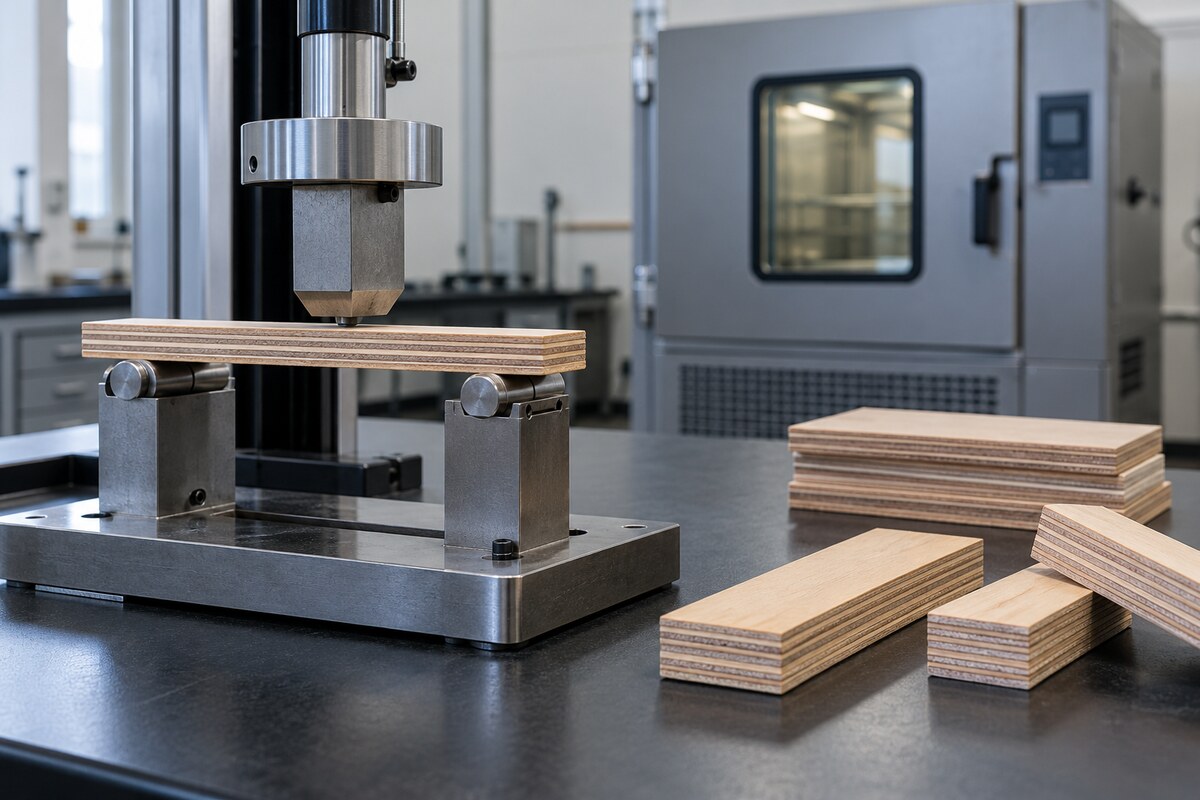
Jeong-Hyeon Kim, Doo-Hwan Park, Sung-Woong Choi and Jae-Myung Lee examined laminated plywood for LNG-carrier insulation in a study published in June 2017. Their comparison used phenol-formaldehyde, or PF, resin plywood and an alternative bonded with melamine-urea-formaldehyde, or MUF, resin. Material bending tests took place at 20°C and −163°C. Resin type, grain direction and test temperature were variables in the investigation of mechanical behaviour and failure.
The study’s plywood was nine millimetres thick and contained seven veneer layers. Two specimen arrangements changed the orientation of the outer and central veneers. One alternated longitudinal and transverse layers beginning with a longitudinal face; the other began with a transverse face. The bending specimens measured 230 by 50 by nine millimetres. Those details define the tested material and configuration. The comparison concerned laboratory specimens and particular loading conditions, rather than establishing a common bending performance for every commercial panel sold for marine applications.

Thickness and rolling shear in birch plywood
A December 2025 study by Hee-Tae Kim, Ki-Young Sung, Jeong-Hyeon Kim and Jae-Myung Lee examined cryogenic rolling shear in birch plywood. The researchers developed an apparatus for assessing in-plane shear under cold conditions and compared nine- and twelve-millimetre panels. Their work addressed plywood used as reinforcement in insulation panels, where it helps protect polyurethane foam from mechanical damage. Loads considered in the study’s context included sloshing impacts, thermal contraction and forces transferred through anchoring components.
Within the tested arrangements, the twelve-millimetre panels had lower in-plane shear strength than the nine-millimetre panels. Cryogenic conditions increased the measured strength of the nine-millimetre panels but reduced it for the twelve-millimetre panels. The thinner panels also displayed a more pronounced dependence on outer-veneer grain orientation. The researchers discussed lathe checks in veneer and changes in adhesive-interface failure as part of the observed behaviour. Their results retain the tested thicknesses, directions and temperatures; they do not describe a universal strength change caused by cooling plywood.
Water exposure and compression measurements
Jong-Min Choi and colleagues investigated plywood compression after seawater, saltwater and distilled-water exposure in a study published in April 2025. The work considered room-temperature testing and cryogenic testing at −163°C. Specimens had two thicknesses, nine and eighteen millimetres, with a 28-by-40-millimetre plan dimension. The authors focused on material behaviour relevant to the NO96 cargo containment system. Their sample dimensions and exposure conditions belonged to that experiment, without identification as a Segezha commercial product.

After three hours of immersion, the room-temperature tests showed increased compressive strength for specimens exposed to seawater and saltwater. Distilled-water specimens instead showed lower strength. The temperature condition mattered: distilled-water specimens tested under cryogenic conditions instead showed increased compressive strength. Changes also varied with longer immersion. Microscopic observations identified differences in veneer–adhesive bonding and buckling. Saltwater-treated specimens showed weaker veneer–adhesive bonds; distilled-water specimens exhibited buckling. These measurements concern compression following specified exposure; they are not a general instruction for treating plywood or deciding whether a ship component can remain in service.
The LNG trading background
Global LNG trade reached 411.24 million tonnes in 2024, an increase of 2.4%, according to the International Gas Union. The trading system connected 22 exporting markets with 48 importing markets. Asia Pacific exported 138.91 million tonnes, adding 4.10 million tonnes over the preceding year.
European imports fell by 21.22 million tonnes to 100.07 million tonnes. The IGU associated that decline with high initial storage, weaker demand and steady pipeline flows, while Asian demand rebounded. These are gas-trade measures for 2024. They are separate from the volume of plywood in an individual supply agreement.

Cargo-containment orders and LNG as fuel
GTT’s two ship-related order categories also have different scopes. During 2025, its core business received orders for 37 LNG carriers, seven ethane carriers and one floating liquefaction vessel. Separately, the LNG-as-fuel business received orders covering 18 container ships and one LNG bunkering vessel. The container-ship design orders rose from 13 in 2024. The specified tank capacities were 12,750 cubic metres for twelve units and 8,000 cubic metres for six. Their tanks were to use Mark III Flex membrane containment, with vessel deliveries planned between the second quarter of 2027 and the fourth quarter of 2028.
At 31 December 2025, GTT’s core order book contained 288 units and excluded its LNG-as-fuel book. The latter stood at 48 vessels after 21 fuel-business vessel deliveries during the year. Those figures appeared in the company’s February 2026 results. They distinguish orders, outstanding work and deliveries, and separate cargo carriers from ships using LNG for propulsion. None of those totals identifies the undisclosed buyer or seven container ships in Segezha’s March agreement.






Leave a comment