
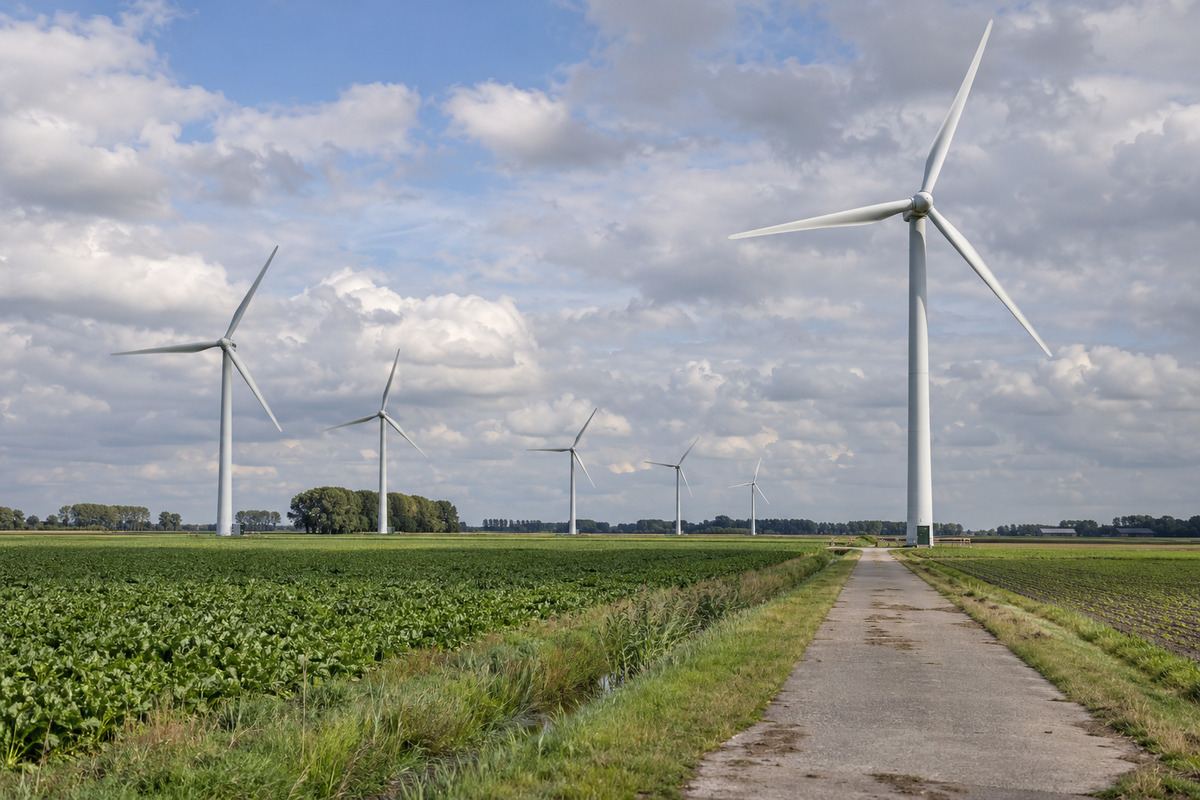
A retired wind turbine can become a source of building components, recovered fibres or chemical feedstock. Its next use depends on which part is being handled. Steel, copper, aluminium and concrete account for much of the mass and have established recycling routes; the composite materials in blades present a different separation problem. Euronews reported in September 2026 that up to 90% of a turbine's mass consists of conventionally recyclable materials. That figure does not describe the recycling rate of an individual blade.
Eva Julius-Philipp, Vattenfall's director of environment and sustainability for its wind business, told the publication that safe life extension and refurbishment should come first. She also described irregular supplies of retired blades and the difficulty of recovering valuable materials without degrading them. Houses and skis offer useful demonstrations, she said, but these applications have not yet become a large-scale answer to the waste stream.
Commitments begin with specific components
Vattenfall's blade policy dates to October 2021. The company committed to stop sending blades from its own wind farms to landfill and instead pursue reuse, recycling or recovery. Its announcement set recycling targets of 50% by 2025 and 100% by 2030. These were objectives attached to a company programme, rather than evidence that either recycling rate had already been reached. The distinction also matters geographically: a restriction adopted by one operator does not establish a national disposal rule.

The programme coupled those targets with research and collaboration across the wind industry. Vattenfall identified material recovery as an area requiring further technological development, rather than treating a disposal commitment as proof that the underlying engineering was solved. The company also supported designing blades for recyclability, aiming to preserve more value in materials recovered at end of life. Its separate references to reuse, recycling and recovery left room for several outcomes for components leaving service, instead of promising that every retired blade would immediately return as another blade.
In September 2024, Vattenfall expanded its circularity commitments to nacelle canopies and rotor nose cones. These covers protect equipment and form the exterior shapes visible at the top of a turbine. Including them extended the programme beyond blades to other large composite components. The announcement also addressed decommissioning contracts, connecting the operator's ambitions with the companies that actually dismantle and handle turbines. Responsibilities at that stage affect whether a component remains available for another use.
The company described a Circular Wind Guide developed with ECHT and the University of Leeds, drawing on a framework by researcher Anne Velenturf. Its purpose was to help apply circular approaches within the wind business. The named options included reuse, refurbishment, repurposing and recycling. Keeping those terms separate gives project teams a more precise choice: retain a working component, repair it, give it a different function, or recover its constituent materials. They need not all follow the same route.
A nacelle becomes a compact house
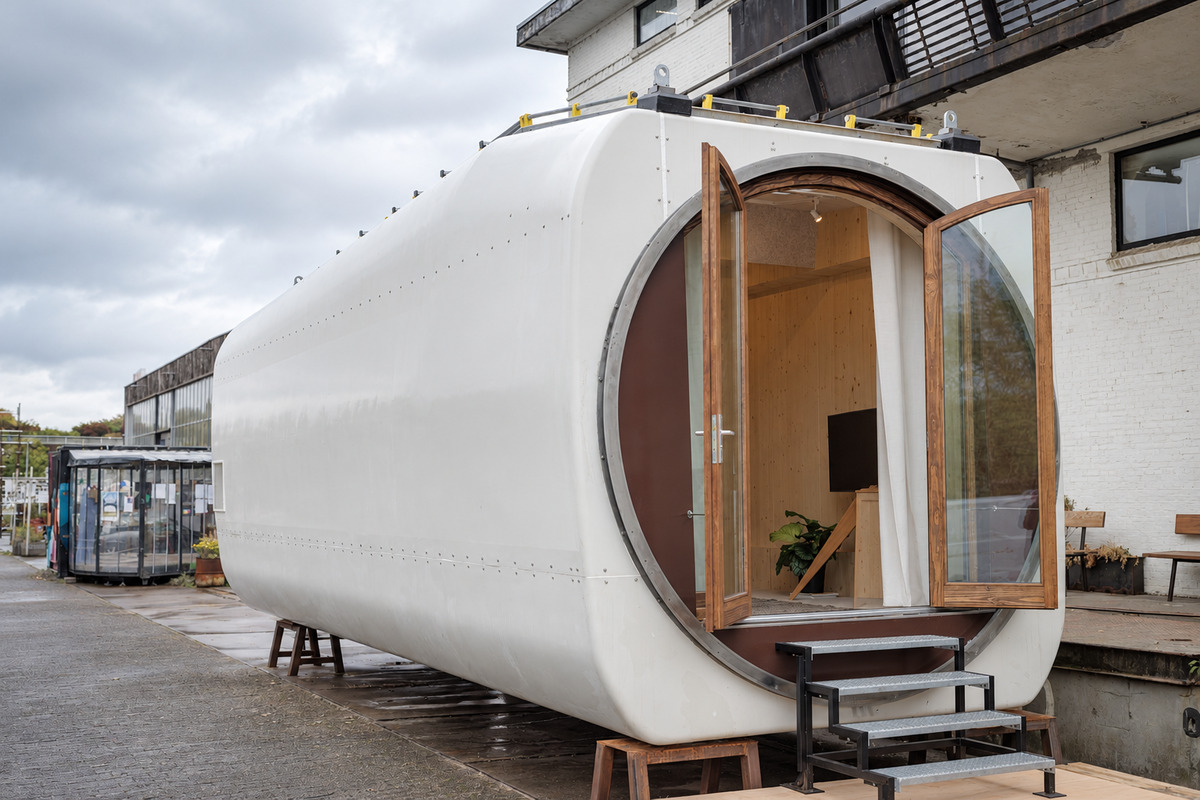
The Tiny House demonstrated what repurposing can look like. Shown during Dutch Design Week in October 2024, it used the nacelle of a Vestas V80 turbine previously installed at Gols in Austria. The original machine was rated at two megawatts. Its cover provided a shell about four metres wide, ten metres long and three metres high. Instead of breaking that enclosure into raw materials, the design retained its recognisable curved form as the outside of a small dwelling.
Superuse and Blade-Made developed the conversion with Woodwave, while Feenstra handled the building installations. The interior incorporated a living area, kitchen and bathroom, alongside a heat pump, photovoltaic panels and solar water heating. Reliving supplied second-hand furniture, including a table associated with Circuform. Business in Wind provided decommissioning expertise. Its account said the house was developed to meet building requirements, a project-specific statement rather than a general approval for converting any turbine enclosure. That list of participants shows the different tasks involved: finding a suitable shell was only one step before fitting services, furnishing rooms and presenting a usable architectural demonstration.
Whole blades find architectural roles
A larger building application followed at the Niels Bohr car park in Lund, Sweden. In December 2025, Vattenfall reported the inauguration of the facility, developed by parking company LKP with architect Jonas Lloyd. Retired turbine blades formed a non-loadbearing facade, rather than replacing the building's main structural frame. The project combined these reused exterior elements with five floors, 365 parking spaces, 40 electric vehicle charging points, rooftop solar panels and a battery system.
The blades came from Nørre Økse Sø in Denmark, a wind farm decommissioned in 2023. Vattenfall donated 57 blades to LKP, but its account explicitly noted that some were not used in the facade. The donation total therefore should not be read as a count of installed building elements. The remaining blades were also the subject of a design competition. This project demonstrates a specific architectural destination for a set of retired components; it does not establish a universal building specification for blades of other shapes, dimensions or condition.
Recovered carbon fibres reach the slopes
The ski project took a different route through the material. In March 2025, Vattenfall described work with Norwegian recycling company Gjenkraft and ski manufacturer EVI. Carbon fibres recovered from blades from the Irene Vorrink wind farm in the Netherlands were used as reinforcement in skis. The partnership with Gjenkraft had begun in 2021. Unlike the house or facade, the new product did not preserve the recognisable shape of the retired turbine component.
Vattenfall ordered 15 pairs, including alpine and carving models and a racing pair. Its announcement invited testing during the World Cup weekend in Åre on 8–9 March 2025; that invitation alone does not establish the results of the trial. EVI founder Endre Hals acknowledged the limited impact a small ski producer could have on the wider waste problem. The case is therefore best understood as an application for recovered reinforcement fibres, rather than a claim that entire skis were made exclusively from blades or that sporting goods could absorb all future blade waste.

Resin chemistry changes the separation problem
Reuse of existing shapes sits alongside efforts to design blades for eventual disassembly. Siemens Gamesa introduced its RecyclableBlade in September 2021, reporting that the first six units, each 81 metres long, had been produced in Aalborg. The supplier described a resin system intended to permit separation of the blade's materials at the end of service. The distinction is in the matrix that binds the reinforcement and other ingredients together, rather than the outward appearance of the finished rotor blade.
That launch announcement also identified customer agreements involving RWE, EDF Renewables and wpd. Those agreements described intended deployments at the time; they were not evidence that every associated wind farm was already operating with the technology. Nor does a blade designed for separation make every other turbine component recyclable by the same process. The supplier's announcement concerned a particular blade technology and its prospective applications, so its scope should remain attached to those products when comparing it with other approaches.
There is also a dated deployment reference. In March 2025, Vattenfall said three sets of RecyclableBlades were in use at Hollandse Kust Zuid. Its account described the new resin being dissolved with a mild acidic solution at low temperature so that materials including glass and carbon fibres, plastic, wood and metal could be separated. This is a specific example of a designed separation route. It should not be extended to older blades whose resins were formulated differently, or interpreted as a claim that those operating blades had already reached end of life and undergone recycling.

Working with the blades already installed
Existing epoxy-based blades present a separate challenge because their chemistry cannot be redesigned after installation. In February 2023, Vestas announced a chemical process intended to break down epoxy composites into reusable materials. The work emerged from CETEC, a collaboration involving Vestas, Aarhus University, the Danish Technological Institute and Olin. The company's central claim was that the approach could address conventional epoxy blades without first changing their design or the composition of the material originally used to manufacture them.
Vestas identified Olin and Stena Recycling as partners in developing the approach toward commercial use. Its announcement described industrial scale-up as a next step, dependent on the process becoming sufficiently mature. A promising chemical result and an industrial recycling service are different milestones. The 2023 statement supports describing a proposed route for legacy material, with named research and industry partners; it does not demonstrate that every retired epoxy blade could already be processed commercially or that a complete collection and recovery network was operating everywhere turbines were being retired.
A prototype tests another resin system
Researchers at the US National Renewable Energy Laboratory explored a different material in work reported in December 2023. They produced a nine-metre prototype blade using PECAN, short for PolyEster Covalently Adaptable Network. Its ingredients included the plant-derived sugar alcohol sorbitol, and the experimental blade combined the resin with glass fibre and balsa wood. The work examined whether a resin made with plant-derived inputs could deliver the mechanical performance required in a blade while also permitting recovery of materials after use.

The laboratory described ester linkages that allow controlled chemical breakdown, alongside testing of properties such as creep, the tendency of a material to deform under sustained loading. Those details connect eventual recovery with the demands of a component expected to carry loads during service. The reported blade remained a prototype, with larger-scale validation still envisaged. Plant-derived ingredients do not by themselves establish that a composite will biodegrade in ordinary conditions, and a demonstration of chemical recovery does not amount to a commercial launch of full-size turbine blades.
From one damaged blade to new products
Another project addressed an existing damaged component. In November 2024, Vattenfall UK reported that Plaswire had processed a 44-metre blade from the Kentish Flats offshore wind farm into its RX Polymer material. The company listed potential product applications in construction, packaging, furniture and logistics. This was a material-recovery example, distinct from retaining a blade as a facade element or recovering only selected reinforcement fibres for sporting equipment. The announcement did not provide a basis for assigning the process to a particular chemical or thermal recycling category.
The release also described plans for a quayside processing line in 2025. Its proposed location was intended to simplify handling and avoid difficult overland journeys with large blade sections. That remained a plan in the dated announcement, rather than proof that the line had subsequently been commissioned. The Kentish Flats example consequently supplies evidence about a particular damaged blade and the material made from it, while leaving the later expansion timetable as an unverified outcome.

Design information and growing material flows
The Dutch Design Foundation's April 2025 account of the Upcycled Turbines programme adds another practical constraint: designers need information about components before they can plan credible second uses. Participants described difficulties obtaining dimensions, manuals and other technical data early enough. The programme involved four studios. Alongside the house, Cepezed tested two 33-metre blades as floating elements at Flevokusthaven near Lelystad before Dutch Design Week 2024. That was an experiment with buoyant structures, rather than evidence that commercial floating housing developments had been built from retired blades.
The foundation's account described a test involving cranes, a low-loader, a diver and a rescue boat, making the logistics visible alongside the design concept. It also reported that, as of April 2025, Vattenfall was not actively investing further in the four concepts, leaving the studios responsible for their continuation. A successful public demonstration and continuing financial backing are therefore separate questions. Access to technical data, equipment and partners remains part of the work needed to move such concepts beyond an exhibition.
The volume question is larger than any single demonstration. WindEurope estimated in November 2025 that annual European blade waste was about 20,000 tonnes in 2025 and forecast roughly 55,000 tonnes annually by 2030. These are yearly blade-waste flows, not the cumulative mass of retired turbines. The association also noted that many machines reaching their theoretical lifetime would continue operating. Its discussion of an industry commitment against landfilling blades described a voluntary sector initiative, not an EU law.
- Capacity: about 80 gigawatts of Europe's installed wind fleet was expected to reach its theoretical lifetime by 2030; this was not a forecast that all those turbines would close.
- Traceability: WindEurope sought dedicated waste codes for blades and permanent magnets, arguing that mixing turbine waste with construction waste made appropriate tracking and treatment harder.







Leave a comment