
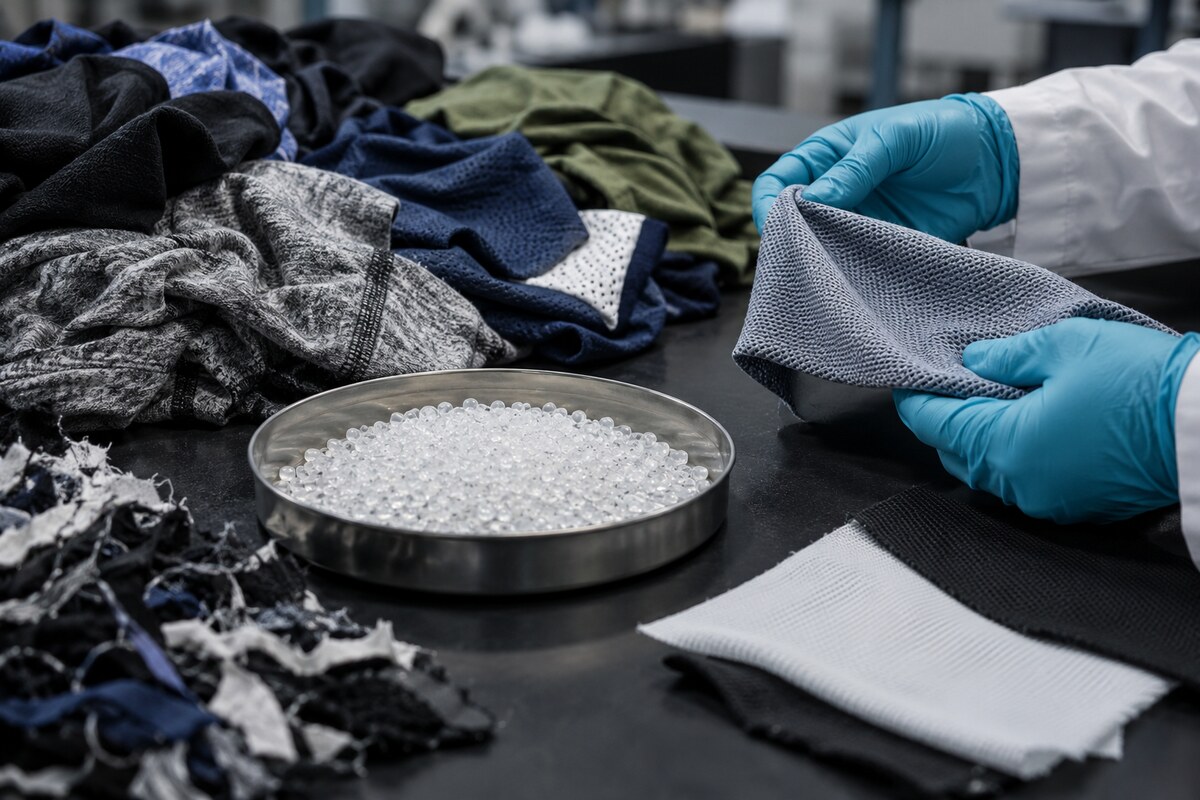
Retailer partnerships and production targets
Syre announced plans to supply recycled polyester to Gap and Target in June 2025. Gap wanted 10,000 tonnes of polyester chips annually; Target envisaged using the material in selected owned-brand products. Chief executive Dennis Nobelius described co-development leading towards commercial agreements, without disclosing their potential value or timing. Partners would spin Syre’s chips into yarn. Houdini committed to sourcing half its polyester from Syre for three years.
The June 24 Reuters report distinguished those commitments from production plans: a North Carolina plant targeting up to 10,000 tonnes annually and operation in 2026, and proposed Vietnamese construction starting in 2027 for 150,000–250,000 tonnes. Syre’s ambition exceeded three million tonnes annually by 2032. These figures represented announced objectives, rather than measured output.

The feedstock behind recycled polyester
Polyester recycling already supplies a substantial fibre market, predominantly using bottles. Polyester production reached an estimated 78 million tonnes in 2024, including approximately 9.3 million tonnes of recycled polyester, according to Textile Exchange’s September 2025 Materials Market Report. Recycled production had risen from around 8.9 million tonnes in 2023, while its share of the polyester market slipped from 12.5% to about 12%. Approximately 98% of recycled polyester originated from plastic bottles. Across the entire fibre market, less than 1% came from recycled pre-consumer or post-consumer textiles. These indicators describe different material streams and denominators: recycled polyester’s share concerns polyester production, while the textile-derived figure covers all fibres. The report’s edition and reporting years matter when comparing these market totals with individual companies’ future supply commitments.
From discarded fabric to chips and yarn
Syre’s planned Cedar Creek system connects a new recycling plant with Selenis’s existing polyester operation. Their adjoining facilities are intended to combine depolymerisation and polymerisation in a continuous production flow. The arrangement also places industrial development close to Syre’s North Carolina research and pilot facilities. In November 2024, Syre identified four stages in its planned process:
- Textile waste from discarded products or production leftovers is shredded, separated from metals and granulated during preparation.
- Depolymerisation breaks the prepared material’s polymer chains down into monomers, the building blocks used in the next stage.
- Polymerisation restructures those monomers into polymers and produces PET chips.
- Partner companies undertake yarn spinning, connecting the recycled material with the subsequent textile-manufacturing chain.
The physical arrangement brings the recycling operation and the existing polymerisation equipment together at one location. Syre presented the facility as a blueprint for larger plants, linking research, process development and production. Its claims of virgin-equivalent quality and improved environmental performance describe the company’s intended product characteristics.

Funding and acquisition of the recycling technology
Syre signed a $100 million Series A funding round in May 2024. TPG Rise Climate led the round, with further investment from H&M and participation by Giant Ventures, IMAS Foundation, Norrsken VC and Volvo Cars. The financing programme covered the North Carolina blueprint facility and preparations for two larger plants. Vietnam and Iberia were the shortlisted regions at that stage. Syre identified apparel, automotive textiles and interiors as target applications for the recycled material.
The equity financing also enabled Syre to acquire the patented technology developed by North Carolina company Premirr. Founders Chris Luft and Matthew Parrott joined the expanded business after an earlier partnership agreement in 2023. Premirr had developed the technology over more than nine years. Nobelius said Syre had evaluated more than 20 polyester-recycling technologies before selecting it. The research and development hub remained in North Carolina, near Research Triangle Park, where the technology originated. These were the technology-acquisition and financing steps announced in 2024.

Vietnam: feedstock access and the investment decision
Access to textile waste was central to Syre’s location work in Vietnam. In May 2025, Nobelius identified the country’s existing textile value chain, potential renewable-energy supply and feedstock availability as reasons for shortlisting it. He also said domestic collection and sorting alone were insufficient for the company’s intended scale. The project therefore envisaged importing textile waste from neighbouring countries. A pilot import licence remained a necessary condition for that approach.
The prime minister’s support allowed detailed work towards a licence to begin; the licence itself had not been secured in that update. An agreement with Binh Dinh province accompanied further evaluation of industrial parks, energy access and business conditions. Procurement manager Wrood Ode was to spend several months establishing the company’s local presence. Documentation for ministerial evaluation and the import-licensing work were still in preparation. Nobelius explicitly retained the possibility of changing location if the conditions could not be established. The update described ongoing site selection and preparation for an investment decision.
Separate collection and the available waste stream
EU member states generated approximately 6.94 million tonnes of textile waste in 2022, equivalent to 16 kilograms per person, according to the European Environment Agency’s March 2025 briefing. The amount had remained relatively stable since 2016. The agency’s capture indicator measures the effectiveness of separate collection systems. In 2022, that rate was just under 15%; around 85% of household textile waste entered mixed household waste. The capture rate had increased by 4.3 percentage points since 2016.

Used-textile exports formed another substantial stream. The EU exported around 1.4 million tonnes in 2023, a volume broadly unchanged since 2019. Those exports pass through trading, sorting and subsequent treatment in destination countries. Their eventual routes include local resale, further exports, recycling and disposal. The EEA described different patterns across African and Asian destinations, with sorting and re-export particularly relevant in parts of Asia. Separate collection, export and eventual treatment consequently appear as distinct stages in the agency’s account of textile flows.
What sorting identifies
Manual assessment of clothing intended for reuse checks features such as damage, stains, pilling, size, style and overall quality. Feedstock for recycling also requires information about fibre composition. Near-infrared spectroscopy identifies material through its interaction with electromagnetic radiation: the resulting spectrum helps distinguish fibre families, single materials and blends. The Joint Research Centre’s 2023 technical assessment described both integrated sorting systems and handheld scanners used for this task. It also identified limitations involving dark fabrics and materials with similar chemical compositions.
Preparation can additionally involve removing buttons, zippers and other non-textile parts. In mechanical recycling, successive tearing opens the fabric and releases fibres. The output can contain fibres suitable for spinning, shorter flock or fluff, and dust. Fibre length and the mix of materials influence subsequent processing. Shorter fractions can enter nonwoven applications, including filling and insulation. These physical outputs belong to a different processing route from the monomers and PET chips generated through depolymerisation and polymerisation.

A sample-based view of European waste
Researchers examined 18 tonnes of waste from Italy, the Czech Republic and Romania between November 2023 and June 2024. Separately collected Italian material was sorted in Bulgaria. The study, published by the Joint Research Centre in April 2025, considered both separately collected textiles and textiles found in mixed municipal waste. It assessed their potential for reuse and recycling, extending the evidence available for southern and eastern European collection systems.
Among textiles sorted for reuse or recycling, approximately 40% were directed towards rewear within the EU. Further shares of roughly 22–23% each concerned reuse outside the EU and open-loop or closed-loop recycling. About three-quarters of the textiles exported for reuse had no noticeable defects; approximately one-quarter had visible defects. The study also identified material compositions compatible with fibre-to-fibre recycling from a technical perspective. Its findings concern the sampled streams, their sorting and assessed potential. They distinguish material suitability from the quantity that a commercial recycling plant ultimately processes.
Composition and sorting research in the United States
Fashion for Good and Resource Recycling Systems launched Sorting for Circularity USA in January 2023 and concluded the project in May 2024. Textile-composition analysis covered seven regions of the United States, with samples collected during spring and summer and during autumn and winter. Near-infrared technology supported the assessment, which focused on cotton and polyester. The work also examined how consumers dispose of textiles and where collection systems could recover more material.

Cotton represented 51% of the residential post-consumer textile stream examined, followed by polyester at 28%. The project assessed 56% of textiles in the waste stream as suitable for fibre-to-fibre recycling. Composition shares and recycling suitability answer separate questions, and the assessment did not measure completed industrial recycling of that entire fraction. The project recommended improvements to collection infrastructure and automated sorting, alongside investment in processing capacity. Its commercial recommendations included longer-term agreements between recyclers and brands and closer alignment between collection costs, processing costs and the value of recovered textiles.
Automated preparation at Amplepuis
Nouvelles Fibres Textiles developed a demonstration line in Amplepuis, France, combining sorting with initial textile preparation. The line classified textiles by colour and composition using digital and infrared technology in 2024. ANDRITZ supplied the line, while Pellenc ST supplied its infrared technology. Alongside sorting, the system removes non-textile components such as buttons and zippers and starts the first tearing stage.
The prepared material then moves to textile producers for further tearing and processing, including spinning and applications in nonwovens and composites. The venture connected two existing specialisms. Eric Boel, general director of Les Tissages de Charlieu, brought experience in weaving, manufacturing automation and recycled textile materials. Etienne Wiroth, general director of Synergies TLC, brought collection and sorting expertise. Their collaboration joined waste-stream handling with textile-manufacturing knowledge. The demonstration equipment described in the 2024 account concerns sorting and mechanical preparation before subsequent processing by other manufacturers.

Business textiles as a feedstock source
Reju and Cibutex signed a feedstock partnership in February 2025. Cibutex brings together textile-service companies that collect and process post-use business textiles. The agreement envisaged supplying secondary raw materials from its members to Reju for regeneration into polyester. Materials were expected to pass through Reju’s Frankfurt Regeneration Hub Zero, which the announcement expected to be fully operational during 2025, and through future hubs. The partners emphasised traceability, quality and the coordination of collection with recycling. Cibutex had been established in the Netherlands in March 2022 by Blycolin Textile Services, Dibella, Edelweiss Groep, Lamme Textile Management and Nedlin. The cooperative’s membership model pooled companies within the textile-service sector. Reju chief executive Patrik Frisk and Cibutex chief executive Jan Lamme associated the partnership with bringing business textiles back into the production cycle. The partners did not publish a contracted annual tonnage.
A proposed industrial hub at Chemelot
Reju selected Chemelot Industrial Park in Sittard-Geleen, Netherlands, for its first industrial-scale regeneration centre in May 2025. The project remained subject to a final investment decision by its parent, Technip Energies. Reju’s earlier Regeneration Hub Zero had opened in Frankfurt in October 2024. Site selection for the larger facility followed that initial hub and the development of upstream feedstock partnerships.
The planned centre’s stated capacity was 50,000 tonnes of rBHET annually. That intermediate would subsequently be repolymerised into PET and converted into polyester, yarn and fabric through the downstream supply chain. The stated rBHET capacity therefore belongs to a particular production stage. Reju uses technology originating with IBM Research and proposes tracing textile waste through its upstream partnerships. Chief executive Patrik Frisk associated Chemelot with scaling the technology and industrial collaboration. The proposed facility and its material flow remained subject to the investment decision in May 2025.

Testing the chain from waste to garments
The EU-funded T-REX project brought together 13 stakeholders across the textile value chain over three years. Its work demonstrated recycling routes for polyester, polyamide 6 and cellulosic materials into new garments. Household collection and sorting formed part of the programme, alongside digital tools, circular-design guidance, lifecycle assessments and work on business models. The project’s results were presented on the EU Textiles Ecosystem Platform in June 2025.
The consortium identified feedstock consistency and access as significant conditions for scaling. It recommended improvements to automated identification of blended or multilayer garments and the co-location of preparation with sorting. Its environmental assessment associated benefits with optimised collection, sorting and logistics and with matching recycling technologies to material types. These were conclusions and recommendations from the project’s research. The resulting blueprint also addressed collection participation, infrastructure and the incentives facing companies along the chain. It situated recycling alongside reuse and repair when describing a more circular textiles system.
A conditional model of recycling economics
Systemiq’s May 2025 study modelled the economics of depolymerising post-consumer polyester textiles in Europe. Its scope covered household clothing, footwear and home textiles. The analysis estimated production costs at around 2.6 times the average cost of virgin polyester in Asia. The comparison therefore combines a defined recycling route and region with a different regional production benchmark. Systemiq described its figures as directional and based on a scaled system, with costs potentially differing during plant ramp-up or when assumed conditions are absent.

Under the combined conditions, European depolymerisation output could rise from around 30,000 tonnes expected before 2028 to 300,000 tonnes annually by 2035. This was a scenario contingent on coordinated changes. The modelling used public information and stakeholder inputs that were averaged and checked. Arc’teryx, Eastman, Interzero, Textile Exchange and Tomra provided financial support. Its assumptions and geographic scope accompany the numerical results, including the distinction between modelled future capacity and operating production.




Leave a comment