

A different composition enters packaging research
LionGlass is a family of glass developed at Penn State, where researchers are working with manufacturers to test applications beyond the laboratory. Verallia’s research partnership, announced in November 2025, concerns consumer packaging. The company’s glass innovation director, Corinne Payen, described the material as a promising alternative to conventional soda lime silicate glass. Its proposed benefits combine a lower processing temperature with a batch that avoids carbonate ingredients. The partnership concerns testing and development, rather than a completed conversion of Verallia’s factories to a new material.
Verallia operated 35 glass production facilities across 12 countries when Penn State announced the collaboration on 05.11.2025. The company had committed to a Net Zero 2040 trajectory, with a planned 90% emissions reduction and measures to address the remaining 10%. Penn State linked the partnership to that corporate programme. The researchers also highlighted glass packaging’s established impermeability and chemical stability, properties that help explain its use for preserving food and beverages. LionGlass still has to meet the requirements associated with those applications.
Glass formation starts with an atomic arrangement
Glass lacks a regular crystalline arrangement. Its atoms remain disordered even though the material is rigid. During glassmaking, a molten mixture cools before its atoms can organize into a crystal lattice. Rapid cooling, often called quenching, preserves that disordered arrangement. Soda lime silicate is one widely used glass family. Natural examples include volcanic obsidian, while manufactured glasses can use metallic alloys and other chemistries. Composition and processing history both belong to the research problem.

Penn State’s glass researchers combine experiments with modeling to investigate those relationships. John Mauro’s group has used the phrase decoding the glass genome for work intended to improve predictions of glass behaviour. The researchers combine fundamental physics with machine learning when designing and studying compositions. LionGlass emerged from that broader programme as a family of related materials, rather than a single universal recipe. By September 2023, the team was working with industrial partners to establish processing conditions and identify applications for different compositions. Those experiments examined properties required in finished products.
Two sources of emissions in the conventional batch
Conventional soda lime silicate glass commonly uses quartz sand, soda ash and limestone. Soda ash is sodium carbonate; limestone supplies calcium carbonate. When heated during melting, the carbonates decompose and release carbon dioxide as well as forming oxides that enter the glass. Furnace energy supplies another source of emissions. Penn State’s initial LionGlass announcement in June 2023 presented a change in batch chemistry and a lower melting temperature as separate approaches to those two parts of production. Removing carbonate ingredients addresses the batch reaction; lowering the required temperature addresses the energy used to melt the material.
Mauro associated a temperature reduction of about 300–400°C with roughly 30% lower energy consumption compared with conventional soda lime glass. These were research estimates, rather than a guarantee for every future furnace or bottle. The team was also exposing different LionGlass compositions to chemical environments to study their behaviour. A patent application covered a family with multiple compositions and potential uses. The chemical testing formed part of establishing where those compositions could be applied. Carbonate-free ingredients do not, by themselves, eliminate emissions from fuel, purchased electricity or the rest of a product’s life cycle.

Crack resistance and hardness measure different properties
LionGlass belongs to an aluminosilicophosphate compositional family. The scientific study published on 04.08.2025 distinguishes resistance to crack initiation from indentation hardness. In the Journal of the American Ceramic Society paper, the tested LionGlass had lower indentation hardness than the reference soda lime silicate glass, alongside substantially higher crack resistance. The researchers defined crack resistance using a 50% probability of cracks forming around an indentation. The conventional glass reached that threshold at approximately 0.1 kilogram-force. LionGlass did not produce enough cracks to reach the same threshold even at 1.0 kilogram-force. The experiment therefore did not establish its precise limiting value.
The same study characterized viscosity and processing temperatures. Its tabulated working range for LionGlass was 540–820°C, compared with 692–1,026°C for one soda lime silicate reference. The calculated annealing temperatures were 439°C and 572°C respectively. The temperature difference varied with the processing stage and reference glass. The authors also described a narrower working temperature range for LionGlass. These measurements concern specific compositions and test conditions. They do not establish that every LionGlass product is ten times stronger in every loading situation, or that a glass container cannot break.
The first industrial partner focused on beauty packaging
Bormioli Luigi became Penn State’s first official corporate partner for LionGlass development in 2024. The glassmaker, based in Parma, Italy, specializes in products including perfume containers, spirits bottles, tableware and wine glasses. The initial collaboration targeted bottles for luxury cosmetics and perfumes. Laboratory manager Elisa Biavardi described the smaller, high-end market as an opportunity to refine the material and examine the feasibility of broader scale-up. The agreement brought the university’s composition research into contact with an established manufacturer’s forming processes, equipment and product requirements.

Before that partnership, Penn State had made LionGlass in laboratory crucibles: small vessels used to hold material while it melts. Industrial manufacturing required larger batches and forming in molds. Part of the first year’s work was to test molding with Bormioli Luigi’s existing infrastructure. The company had experience with electric melting, including electric furnaces at its Parma plant since 1986. At the time of the 2024 announcement, it used electricity for 65% of group production.
What the Murano pilot actually produced
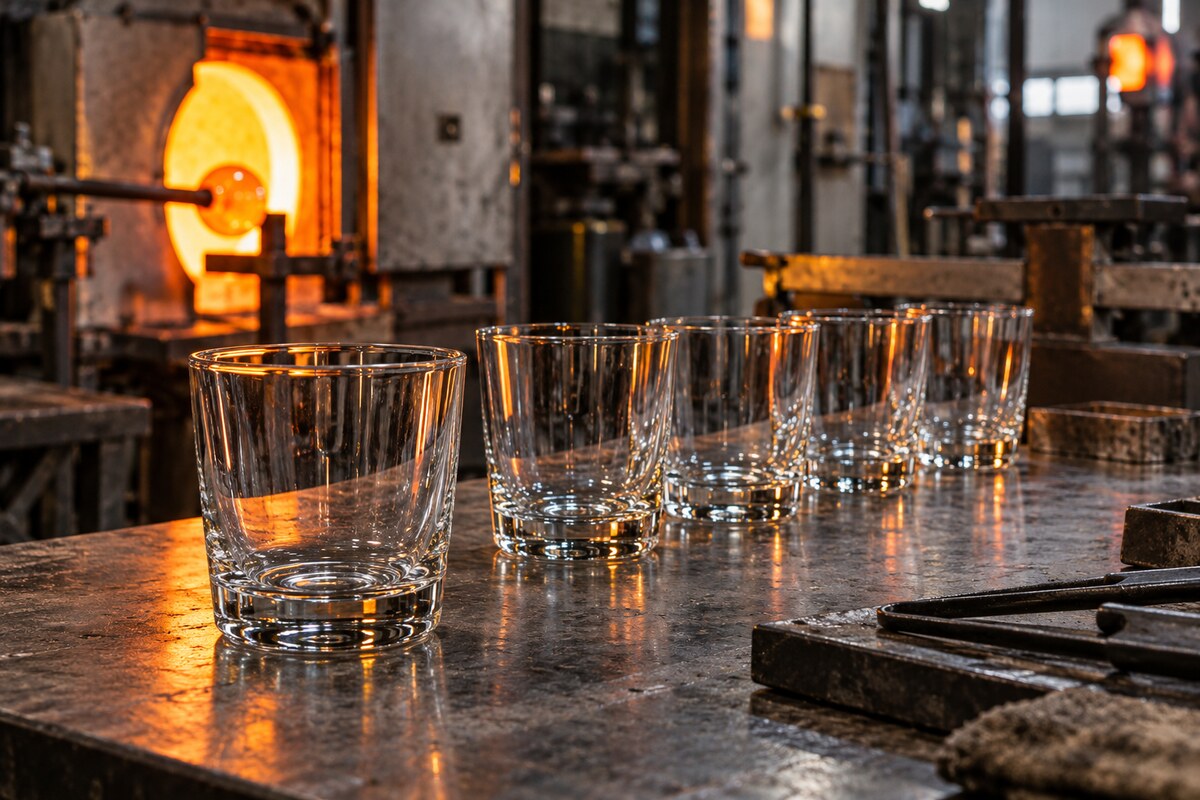
Penn State researchers joined Bormioli Luigi glassmakers in Murano in March 2025 for a two-day trial. They melted two 100-kilogram batches in a rented artisanal gas-fired furnace and formed more than 150 clear cups. The pilot trial tested the material at a larger scale than the university’s usual laboratory melts. Its equipment was not a furnace designed for the largest continuous production operations. The successful production of cups was a pilot result with that specific scale and setup, rather than a full commercial manufacturing launch.
The cups passed through an annealing lehr, where controlled cooling helps manage stresses in newly formed glass, and were inspected for defects. Nicholas Clark said the trial demonstrated formability while retaining transparency and a smooth surface. Bormioli Luigi and Penn State subsequently signed a second-year agreement. Further work concerned mechanical performance and chemical durability, including compositions containing strontium oxide. Another Italian trial was anticipated. The partners were continuing to develop compositions for manufacturing and customer use, rather than treating one successful trial as the end of qualification.

Spirits bottles, licensing and separate recycling streams
Verallia’s project examines LionGlass for spirits bottles. Mauro told Manufacturing Dive that higher-end spirits offered a potential entry point because volumes were smaller and margins higher than in parts of the commodity beverage market. The partners needed to assess durability, interaction between beverages and packaging, and compatibility with Verallia’s manufacturing processes. In November 2025, he expected a prototype could take a year or two.
The team intended to license LionGlass through the Penn State Research Foundation to established glassmakers, rather than create a competing startup. Discussions with partners included intellectual-property exclusivity. Recycling introduced another requirement: LionGlass and conventional soda lime silicate glass should not share a recycling stream, Mauro said. A doctoral researcher was studying that problem, and the team was working with a sorting-equipment company on distinguishing the two materials. The separate-stream requirement belonged to the commercialization programme alongside forming and durability tests. Existing collection arrangements for conventional bottles were not presented as a finished recycling solution for LionGlass.
Later research extended the programme to flat glass
On 17.12.2025, Penn State announced a multi-year research agreement with Vitro Architectural Glass. The project, scheduled to run through July 2028, concerns architectural and automotive flat glass. Its central manufacturing task is adapting LionGlass to the float process, in which molten glass spreads over a bath of molten tin. The partners planned to optimize compositions and evaluate compatibility with industrial float operations. They also planned tests involving downstream processes used for architectural, automotive and solar glass. The agreement was a research programme with future work, rather than an announcement of finished LionGlass windows or windshields for sale.

Vitro had four float lines in Pennsylvania, two in Carlisle and two in Meadville, when the agreement was announced. Daniel Kramer, who had earned bachelor’s and master’s degrees at Penn State, was to return for doctoral research and work on the project alongside Clark. Flat glass required evaluation in a float operation and in subsequent processes associated with its intended markets.
The conventional production steps awaiting a new material
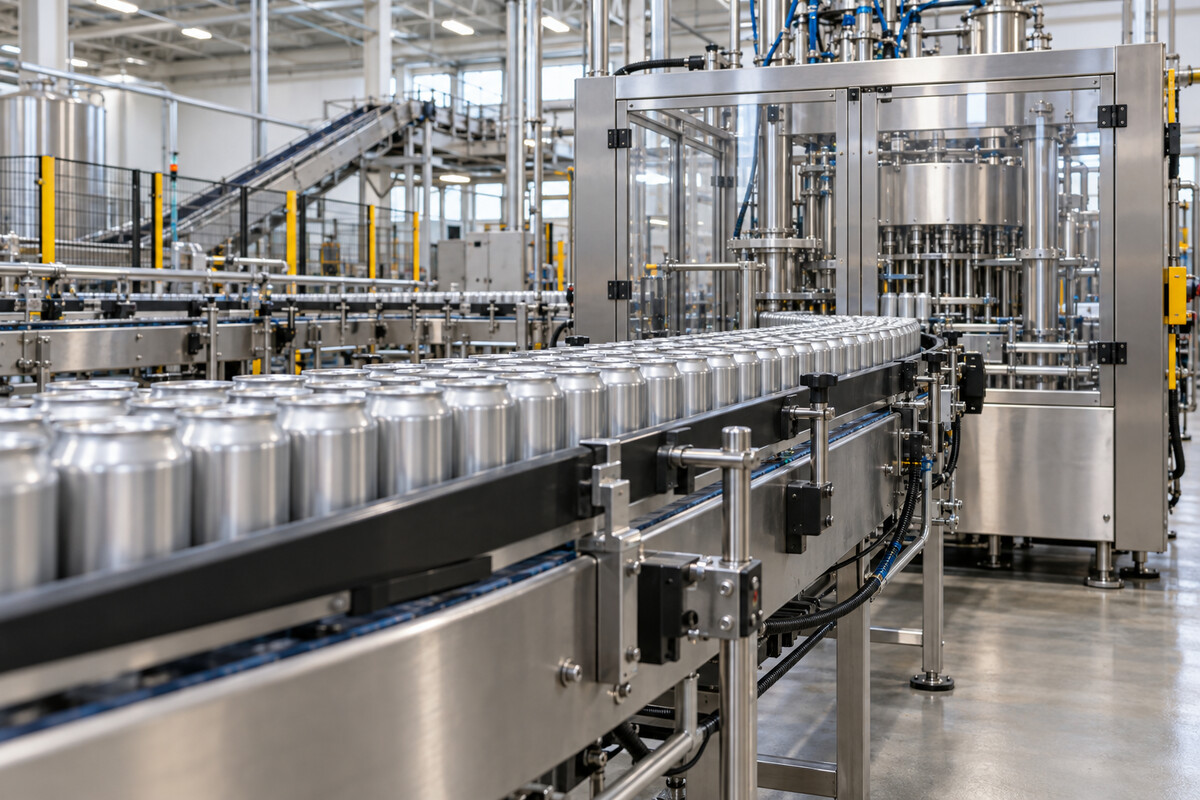
Verallia’s manufacturing process begins with product design and the selection and mixing of raw materials, including recycled glass known as cullet. Melting produces a homogeneous liquid that moves through distribution channels to forming machines. For bottles and jars, the glass takes shape in two stages, first in a blank mold and then in a finishing mold. Some versatile production lines can make up to three different types of item. The newly formed containers leave the machines at temperatures above 500°C before continuing through the rest of the production sequence.
An annealing tunnel relieves internal stresses in the glass, and containers receive a treatment intended to resist scratching. Before containers are palletized and covered for shipment, individual inspection checks several product characteristics:
- Closure dimensions and the fit required for sealing.
- Pressure resistance for sparkling beverages.
- Glass thickness and the container’s appearance.
Electric melting supplies a separate industrial comparison
Verallia inaugurated an all-electric furnace at Cognac in France on 10.09.2024. The project involved an investment of €57 million and a partnership with industrial engineering group Fives. Its stated daily capacity was 180 tons, equivalent to approximately 300,000 bottles. The furnace concerned flint and extra-flint glass for packaging, including bottles for Cognac brands. Verallia associated the installation with a 60% reduction in carbon dioxide emissions compared with a traditional furnace. That figure was the company’s comparison for this furnace project, rather than a measured reduction attributed to LionGlass.
The Cognac installation benefited from low-carbon energy available near the site and support from ADEME through the France 2030 programme. At its inauguration, the company presented it as part of a broader effort to change its industrial equipment and energy consumption. Electrification concerned the way heat was supplied to the melting operation. The LionGlass collaboration concerned a different glass composition and its processing requirements. The two projects therefore had their own equipment, materials, comparisons and qualification work; the Cognac announcement did not announce a LionGlass furnace.
Other measures remained part of Verallia’s programme
In March 2025, Verallia set out several approaches within its decarbonization programme. Alongside electric melting, it described hybrid furnaces intended to obtain up to 80% of their energy from electricity, with 20% from gas or other lower-carbon alternatives. The company associated those installations with a potential 50% emissions reduction. It also retained a goal of reducing Scope 1 and Scope 2 emissions by 46% by 2030 from 2019 levels. These statements concerned company targets and technology plans, with different boundaries from the research estimates associated with a new glass composition.
Verallia’s other measures included lighter bottle designs, greater use of recycled cullet, photovoltaic installations, biofuels, syngas production and recovery of residual heat for electricity. It supported glass-reuse projects in Europe as well. Its March statement included a target of integrating 59% recycled cullet into production by the end of 2025; that target was not a reported year-end result. Lightweighting concerned the quantity of material in a package and its transport requirements. Reuse concerned another route through a packaging system. Neither initiative, by itself, established that a new LionGlass composition had passed commercial packaging tests.
Recycling depends on preparation and compatible material
Conventional cullet replaces part of the virgin material in a glass batch. Its use can reduce demand for sand and sodium carbonate, lower the energy needed for melting and reduce emissions associated with carbonate raw materials. Verallia estimates that recycling one ton of cullet saves an average of 1.2 tons of virgin raw materials. It also associates an additional 10% cullet in production with a 5% reduction in furnace carbon dioxide emissions and a 2.5% reduction in energy consumption. Those relationships are the manufacturer’s technical estimates for cullet use, not test results for a mixed LionGlass recycling stream.
Collected glass must be sorted, cleaned of impurities and crushed before it becomes usable cullet. Material can come from a plant’s own production or from outside collection. Verallia identifies availability as a constraint on incorporating more recycled glass and notes that technical incorporation can reach 95% for certain colours. The company participates in Close the Glass Loop, a European initiative targeting 90% glass collection by 2030. It brings together organizations representing glassmakers, recycled-glass preparers, brands, local authorities and packaging collection. These collection and preparation activities concern the existing glass system.












Leave a comment