
Freedom Pines and the supply challenge
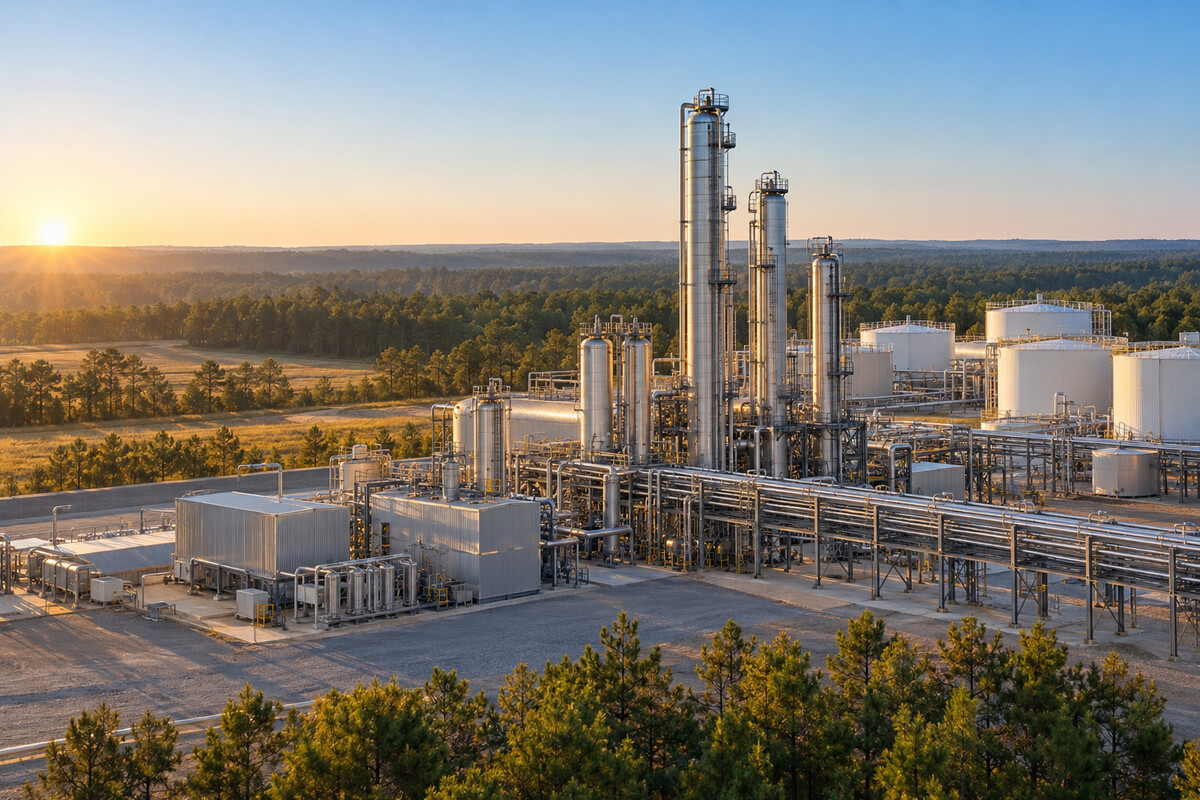
Freedom Pines Fuels in Soperton, Georgia, was preparing to turn ethanol into aviation fuel in the United States when Bloomberg’s April 2024 coverage put the plant’s cost at $200 million. LanzaJet planned nine million gallons of sustainable aviation fuel, or SAF, annually. CEO Jimmy Samartzis expected initial use of Midwest corn ethanol, followed over three to six months by sugarcane ethanol from Brazil. That was a startup timetable. Feedstock availability and environmental effects remained contested: Possible campaigner Alethea Warrington questioned the systemic consequences of supplying aviation’s fuel demand. University of British Columbia researcher Susan van Dyk warned that technologies still needed to become commercial and ramp up. Those concerns accompanied a search for alternatives to the waste oils and animal fats supplying much existing SAF production.
A specified sugarcane pathway
The EPA’s 12 January 2023 determination addressed a defined Soperton production pathway. It covered renewable jet fuel and renewable diesel made from undenatured sugarcane ethanol through dehydration, oligomerization and hydrotreating. Grid electricity, natural gas and hydrogen were specified process inputs. Qualifying fuels could generate D-code 4 renewable identification numbers under the Renewable Fuel Standard, subject to applicable requirements and facility-specific conditions. EPA estimated lifecycle greenhouse-gas reductions of approximately 54–66% against the statutory petroleum baseline. That calculation combined ethanol-production assumptions with modeled Soperton process data and fuel distribution and use. It was a pathway assessment, rather than a measurement of annual plant performance. Other ethanol feedstocks required further consideration; the approval applied to the particular facility, materials, process and energy inputs described in the petition.

Modules and the balance of plant
By 20 April 2023, LanzaJet and Thompson Construction Group had set the final modules of the biorefinery structure, which rose more than ten storeys. Work on the remaining site infrastructure continued, with completion and commissioning then planned for late 2023. Thompson and Zachry Sustainability Solutions had participated in construction since August 2022. Zeton led the modular construction approach before the equipment was erected at Soperton. LanzaTech’s original engineering incorporated Technip Energies’ Hummingbird ethanol-to-ethylene technology. Thompson’s capital-projects vice-president Bill Bryant identified the next work as completing the balance of plant and preparing turnover and commissioning. LanzaJet said long-lead equipment was arriving and offtake agreements covered all fuel production for ten years. The plant was being prepared for combined annual production of ten million gallons of SAF and renewable diesel.
An opening followed by startup work
LanzaJet held the Freedom Pines opening on 24 January 2024. The facility in Treutlen County, less than 100 miles from Savannah, had a stated design of ten million gallons a year across SAF and renewable diesel. Samartzis described technology refinement as part of starting up the plant, alongside work on further projects internationally. The opening brought together public officials, local representatives and the company’s investors and supporters. Shareholders represented included International Airlines Group, LanzaTech, Mitsui, Shell and Suncor Energy. LanzaJet also placed the plant within a longer development programme that had supplied fuel for Virgin Atlantic and All Nippon Airways commercial-flight demonstrations in 2018 and 2019 respectively. At the opening, LanzaJet projected more than 250 total jobs and an estimated $70 million in annual economic activity locally.

Fuel from an integrated plant
On 13 November 2025, LanzaJet announced full operation of the integrated Freedom Pines plant and production of jet fuel meeting ASTM specifications. Its integrated system combined Technip Energies’ Hummingbird ethanol-to-ethylene technology with oligomerization technology developed by the Department of Energy and LanzaTech. LanzaJet had engineered, built and brought those elements into operation together. The company described SAF blending with Jet A-1 as the route to a certified fuel compatible with existing aircraft and infrastructure. LanzaJet gave no full-year output total with that operating announcement. At that stage, LanzaJet put development investment at more than $300 million and employment at over 300 people during construction, with more than 65 direct and indirect ongoing jobs. These were the company’s November 2025 figures, distinct in date and description from the April 2024 plant-cost estimate.
Airline investment and residue-based ethanol
Southwest Airlines invested $30 million in LanzaJet in February 2024. Their agreement paired project development for another American SAF facility with support for SAFFiRE Renewables, a company developing conversion of corn stover into ethanol. Southwest was intended to become the proposed refinery’s anchor SAF buyer. LanzaJet would support efforts to commercialize SAFFiRE’s technology, with its cellulosic ethanol potentially becoming feedstock for aviation-fuel production. The arrangement therefore connected an airline’s prospective fuel purchases with development of an upstream ethanol source. Southwest chief executive Bob Jordan linked the investment to the airline’s goal of replacing 10% of its jet-fuel consumption with SAF by 2030. That percentage was a corporate objective. Both the proposed biorefinery and the residue-to-ethanol process remained development initiatives at the time of the investment.

Airbus joins the investor group
Airbus made a strategic investment in LanzaJet in July 2024 as part of a growth-equity round. LanzaJet did not disclose an investment amount. LanzaJet intended to use the backing to increase its ability to deploy its proprietary ethanol-to-SAF process. Other investments announced during that period came from Southwest Airlines, Microsoft, Groupe ADP and MUFG. Airbus chief sustainability officer Julie Kitcher characterized SAF production as limited and described cooperation with technology suppliers as part of the aircraft manufacturer’s response. LanzaJet’s wider investor and funder group also included British Airways, All Nippon Airways, Mitsui, Shell and Suncor. The company described projects spanning 25 countries and five continents. That was the geographical reach of its development portfolio, rather than a count of operating production plants.
CirculAir connects two conversion stages
LanzaTech and LanzaJet launched their joint CirculAir offering in June 2024 while remaining independent companies. The proposed chain first uses LanzaTech’s gas-fermentation technology to make ethanol from carbon-containing resources. LanzaJet’s alcohol-to-jet stage then converts that intermediate into SAF and renewable diesel. The companies identified municipal waste, agricultural residues and industrial carbon emissions among potential inputs, alongside routes involving captured carbon dioxide and renewable power. Ethanol remains the intermediate entering the ATJ stage. The partners described CirculAir as an alternative route to waste-derived fuels, power-to-liquids and e-fuels, using an already approved ethanol-based aviation-fuel pathway. The partners forecast emissions savings of at least 85%, depending on the feedstock. Their joint projects already included developments in several markets, with the two independent technology providers combining their capabilities in one commercial offering.

Speedbird’s British development programme
Project Speedbird brought together LanzaJet, British Airways and Nova Pangaea Technologies. A November 2023 announcement identified £9 million, also stated as $11.2 million, in support from the Advanced Fuels Fund in the United Kingdom. Nova Pangaea’s process would turn agricultural waste and wood residues into ethanol, followed by LanzaJet’s conversion into aviation fuel. Initial processing was planned through Soperton ahead of a larger British ATJ facility. British Airways intended to purchase all SAF from the project. At that stage, the partners planned 27 million gallons, or 102 million litres, of SAF annually, with a British facility built by 2027 and full capacity in 2028. IAG, British Airways’ parent, had been a founding LanzaJet shareholder since 2021 and had invested in Nova Pangaea during 2023.
LanzaJet selected Wilton International in Teesside for Speedbird in January 2025, partnering with Sembcorp Utilities (UK), part of Sembcorp Industries. The company pointed to the site’s location, infrastructure, energy and utilities as reasons for its selection. British Airways continued as a project partner. The plans described a sustainably sourced ethanol input and specified:
- More than 90,000 tonnes, also described as 30 million gallons, of combined SAF and renewable diesel annually.
- Around 30 long-term operational positions at LanzaJet.
- A projected reduction of approximately 230,000 tonnes of net carbon dioxide emissions each year.

Fluor received Speedbird’s front-end engineering and design assignment in November 2025. LanzaJet’s announcement again described a proposed commercial-scale ethanol-to-SAF facility in Teesside, developed with British Airways’ support. The company also identified a recent £10 million, or $13 million, Advanced Fuels Fund award. That grant was a separate dated announcement from the £9 million funding identified in 2023. Fluor’s project-execution group president Mike Alexander described the engineering company’s participation as work on the project’s development. LanzaJet projected hundreds of jobs across construction and operation, a broader employment scope than the long-term operating roles identified at site selection. LanzaJet continued to identify Speedbird as its next commercial-scale development, with Fluor providing engineering and design expertise for the proposed facility.
Projects at different development stages
In August 2024, Wagner Sustainable Fuels joined LanzaTech and LanzaJet in evaluating CirculAir for Wagner’s proposed Brisbane SAF refinery. Boeing and the Queensland Government had invested in the project. The proposed system would combine local waste resources, including industrial emissions and municipal waste, with the two companies’ ethanol and ATJ technologies. Wagner chief executive Matt Doyle presented the partnership as a way to advance a domestic fuel-production facility. LanzaTech chief executive Jennifer Holmgren emphasized the availability of different waste-carbon resources, while Samartzis described the combination of upstream carbon recycling and downstream fuel conversion. Wagner’s Brisbane refinery was the subject of a technology evaluation under this partnership. Its proposal was separate from Jet Zero Australia’s development elsewhere in Queensland.
Jet Zero Australia and LanzaJet had announced their Queensland collaboration in March 2023. Qantas and Airbus were to invest a combined A$2 million in early-stage capital, within an A$6 million total raise supported by government and other investors. The two aviation companies’ wider US$200 million Australian SAF partnership was a separate funding framework. Jet Zero’s project partners would undertake feasibility and early development work for an ethanol-to-SAF plant. The proposal envisaged up to 100 million litres of SAF annually from agricultural by-products such as sugarcane. Construction was then expected to begin in 2024. Jet Zero chief executive Ed Mason referred to a heads of agreement and feasibility work. Qantas had set a target of using SAF for 10% of its overall fuel consumption by 2030 and achieving net-zero emissions by 2050.
Air New Zealand and the Ministry of Business, Innovation and Employment selected LanzaTech and LanzaJet for the second stage of a domestic SAF study in June 2023. Forestry residues were the principal local feedstock under consideration. LanzaTech would examine supply-chain risks and the potential to convert waste resources into ethanol; LanzaJet would provide the ATJ stage. Z Energy, an Ampol subsidiary, joined to evaluate the complete supply chain, feedstock options and regional economic effects. The study followed a year-long request-for-proposals process. Partners needed to demonstrate technical, economic, supply-chain and environmental viability before proceeding. Completion was expected around mid-2024, after which a decision on further development and engineering would follow. Air New Zealand and the government were investing to support the study, which would test the viability of a commercial domestic fuel supply chain.

Cosmo Oil’s Japanese project with Mitsui moved through a funding milestone in February 2025. LanzaJet announced Cosmo’s selection for a fiscal-2024 subsidy from the Ministry of Economy, Trade and Industry for a project planned around its ethanol-to-SAF technology. Cosmo would contribute experience in plant operation, fuel-quality control and logistics, while Mitsui would bring ethanol-procurement capabilities. The proposed Sakaide Logistics Base facility had a 2029 start target. Its planned annual products were approximately 150,000 kilolitres of SAF and 17,000 kilolitres of renewable diesel, stated as separate fuel streams. Cosmo’s selection for subsidy support advanced project development. Its annual fuel quantities remained conditional on completion of the planned production facility, with 2029 as the partners’ stated production-start target.
BioD launched a Colombian feasibility study with LanzaJet in May 2025 after evaluating more than 20 technologies over more than three years. The partners selected ATJ and planned to assess the technical, economic and operational requirements of a domestic SAF plant. BioD project leader Carolina Betancourt identified agroforestry residues and energy crops intended to meet CORSIA eligibility requirements as prospective resources. The initiative targeted integration of SAF into Colombia’s energy supply by 2029. BioD brought experience as a biodiesel producer, describing more than 17 years of operation in its 2025 company background. The new study concerned expansion into aviation fuel, alongside its existing renewable-fuel activities.

Kazakhstan’s KMG and LanzaJet completed a joint feasibility study and agreed to proceed to FEED in September 2025. The agreement accompanied New York Climate Week meetings involving Samartzis, President Kassym-Jomart Tokayev and KMG chairman and chief executive Askhat Khasenov. The next development phase was intended to settle the technical and economic solutions needed for construction. KMG and LanzaJet expected work on that phase to follow the agreement. Their announcement placed anticipated Kazakh SAF demand at 70,000 tonnes annually by 2030. That figure described expected market demand, rather than the proposed plant’s capacity or delivered output. Khasenov linked the work to Kazakhstan’s low-carbon development goals and anticipated benefits for its biofuels market, aviation sector and transit activity.
Financing the next operating phase
On 15 October 2026, LanzaJet announced at least $20 million of fully committed new financing for growth and Freedom Pines operations. A first closing had occurred on 14 October, with full closing expected by December. LanzaTech, Vinod Khosla and the LanzaJet board supported the transactions as part of a broader recapitalization and reduction of debt. LanzaTech was expected to increase its ownership significantly; LanzaJet did not specify the resulting ownership percentage. Jennifer Holmgren would continue as LanzaJet board chair and support its plan as interim chief executive, alongside her LanzaTech leadership role. The company again described Freedom Pines’ ten-million-gallon annual capacity and production of specification-compliant SAF and renewable diesel. The company identified existing Brazilian and American ethanol supply, regional feedstocks and harder-to-access waste-carbon resources as inputs its projects could draw on.


Leave a comment