
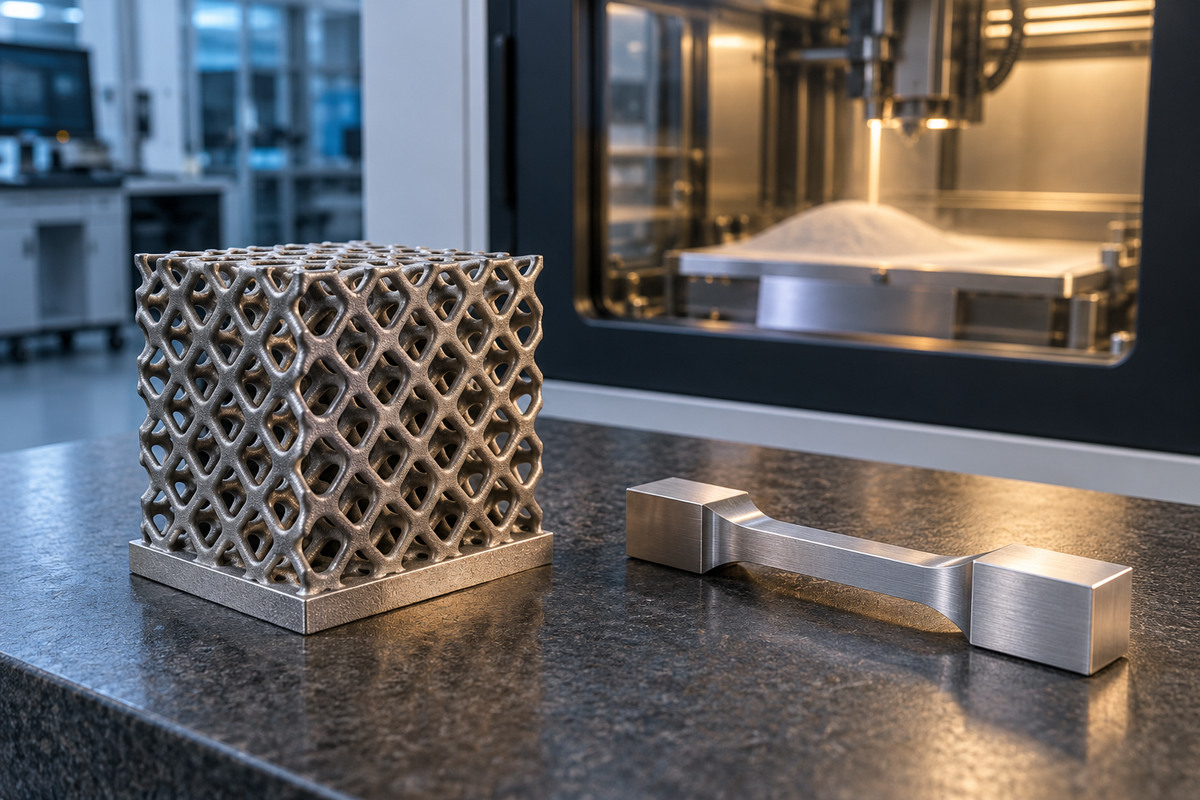
A shared laboratory for metal manufacturing
Lab22 brings metal additive manufacturing, machining and surface engineering into an industry research setting in Australia. CSIRO established the centre in 2015 to work with manufacturers on processes and products. Its capabilities span powder-bed printing, cold spray and blown-powder techniques, with titanium, aluminium, ferrous and nonferrous materials among the available options. Sand printing also belongs to the centre’s broader manufacturing capabilities. Different machines and feedstocks support different applications within that shared research environment.
The equipment includes an Arcam A1, Concept Laser M2, Optomec LENS MR-7 and SLM280 multi-material printer, alongside a large-format robotic system developed by CSIRO. Laser-assisted deposition and laser heat treatment extend the work beyond making an entire component layer by layer. CSIRO’s research agenda also includes metal-matrix composites, robotic freeform manufacturing and computational models. Industry collaboration connects these facilities with companies exploring production methods, component design and commercialization; a particular process still has to suit the material and application.
Equipment access across several states
Defence Trailblazer and CSIRO announced an equipment partnership on 16.09.2024, with a $7.5 million acquisition covering three equipment packages across New South Wales, South Australia and Victoria. The packages included quantum packaging facilities, a diamond-turning machine and a robotic additive manufacturing cell. The partnership connected the University of Adelaide and UNSW with CSIRO facilities, offering industry access to prototyping, testing and low-scale manufacturing capabilities. More than 70 industry partners were involved in the Trailblazer initiative. The robotic cell formed one part of this geographically distributed acquisition, alongside equipment serving other manufacturing needs. The network connected companies with research facilities and expertise across the participating organizations.
A separate partnership announcement on 29.10.2024 placed the manufacturing facilities within a wider funding framework. The $45 million CSIRO partnership sat within the Australian Government’s $370 million Trailblazer Universities Program, while the initiative’s anticipated industry co-investment had a different, $648 million basis. These figures describe different parts of the program rather than interchangeable estimates for Lab22 equipment. Three machines at Clayton were highlighted: a PX100 binder-jet system, an SLM280 2MA multi-material printer and a robotic manufacturing cell. Their applications extended across national manufacturing priorities, with access intended to connect companies and universities to research infrastructure. SpiroPak’s structured packing was among the industry opportunities associated with this capability. The work concerned developing manufacturing routes for products used in separation processes.
Printing different metals in one build
CSIRO commissioned a Nikon SLM280 multi-metal printer at its Clayton site in March 2024 through the iLAuNCH partnership. The system can place different metals side by side during one continuous print, giving designers a route to components with different material properties in different regions. The commissioning connected CSIRO’s manufacturing research with aerospace development and the companies taking part in iLAuNCH. The program’s $180 million value covered the broader initiative rather than the purchase price of this individual printer.
Multi-material printing extends part consolidation beyond combining several shapes into one object. A component can incorporate materials selected for different functions while retaining a single printed form. CSIRO had already worked on hybrid titanium and Invar satellite components, where material selection and the interface between materials were central concerns. The Clayton commissioning added equipment for further work in this direction.

Several machines, several process routes
CSIRO’s equipment presentation at a December 2025 light-metals conference distinguished the printing routes available to researchers. The presentation listed Arcam A1 and Q10 equipment, with operating environments and material capabilities specific to those systems. Each process has its own equipment envelope and material considerations. The equipment supports these different routes:
- Concept Laser M2: laser powder-bed processing.
- Arcam: electron-beam melting in a vacuum.
- LENS: powder-fed deposition.
The Optomec LENS system instead supplies powder to a deposition process, with four powder feeders available in the equipment configuration. CSIRO’s robotic cell supports a much larger working envelope, listed as 3.2 by 1.2 by 1.2 metres. The SLM280 2MA provides a powder-bed route for multi-material work. Those specifications describe research equipment capabilities, rather than annual factory output.
A later bimetal spacecraft demonstrator
Space Machines Company developed a bimetal rocket thruster that Lab22 manufactured using the Nikon SLM280 2MA, announced on 25.09.2025. The component combined a steel outer jacket with a copper-alloy region serving a thermal function. Both metals were incorporated during printing. The arrangement assigned different material properties to different parts of the component, rather than treating a single alloy as the answer to every requirement. Space Machines Company’s Scintilla propulsion technology and the planned Optimus Viper spacecraft supplied the application context for the demonstrator.

The thruster collaboration involved the iLAuNCH program, led by the University of Southern Queensland with the Australian National University and the University of South Australia. More than 25 partners participated in the wider initiative. Manufacturing the demonstrator was an achieved step; its proposed use aboard Optimus Viper remained a subsequent objective in the September announcement. The project also prompted discussion of multi-metal applications in tooling, heat exchangers and automotive manufacturing. Those possible uses remained distinct from the particular spacecraft component that had actually been printed.
Robotic repair begins with programming
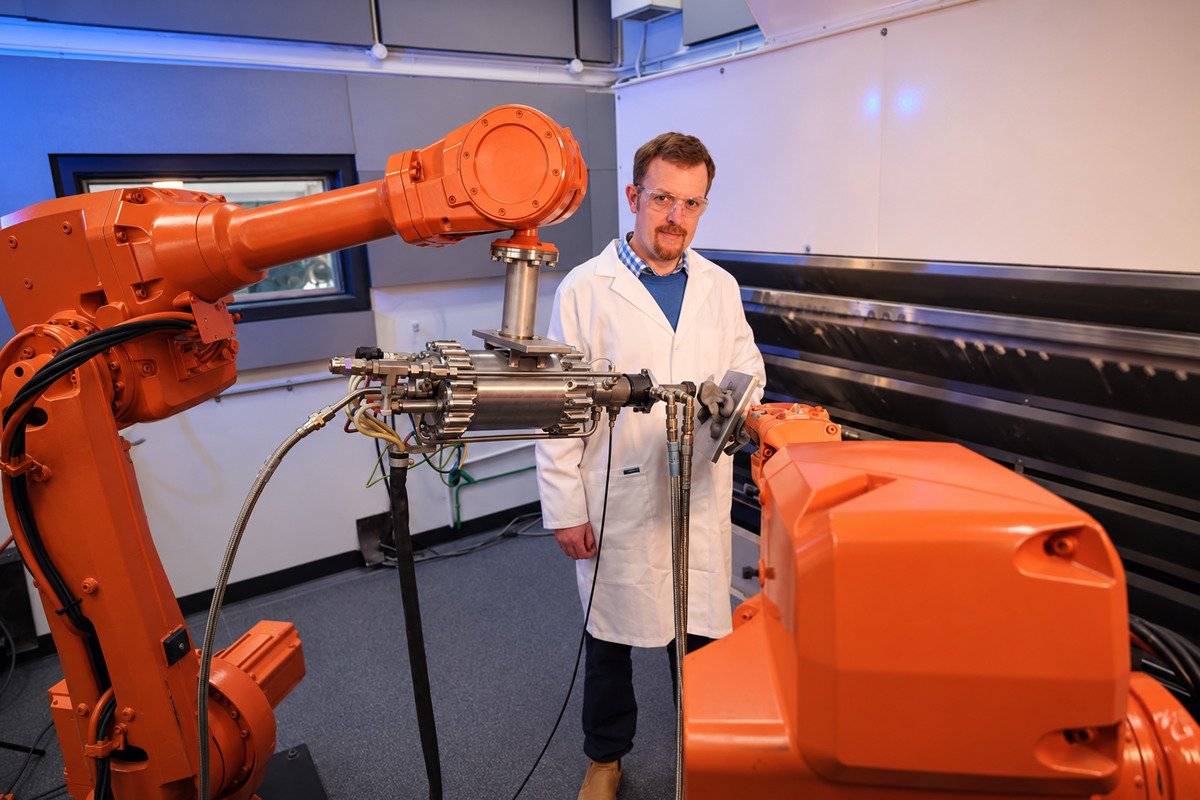
Peter King’s Continuous3D work at CSIRO addressed the effort required to program robots for maintenance. A production robot can repeat a task in a controlled setting, while repair work presents changing shapes and surfaces. Scanning and software were central to the proposed approach: the system would gather information about the object and use it to guide robotic work. The development connected King’s technical experience at Clayton with the practical requirements of businesses carrying out industrial maintenance on components that varied from job to job.
King took the idea through CSIRO’s ON programs. ONPrime supported customer interviews that tested whether the maintenance problem mattered to potential users. ONAccelerate then provided business development support, including coaching, mentoring and preparation for investor discussions. By June 2024, Continuous3D was being developed toward a potential startup, with a commercial proposition still taking shape. Technical development, customer research and preparing a pitch were separate activities within that effort.
Scanning a surface and generating a toolpath
By November 2025, Continuous3D’s repair work combined laser scanners, a computer and a robot to generate toolpaths for changing component surfaces. Six degrees of freedom allowed the robot to follow curved surfaces during repair and coating work. The software ran on a local computer without requiring a cloud connection, keeping processing and industrial data on site. Robots with payloads of 20–60 kilograms were part of the described approach. That range referred to the robot’s handling capacity, rather than the quantity of metal deposited in an hour.
Development involved aerospace and mining applications, including coating engine castings and evaluating mining components. These were trials and evaluations, with collaborators still being sought. King envisaged mobile equipment for future on-site repairs and potential extensions into polymers, composites and concrete. Sensing, automated path generation and work on industrial parts formed the development program; broader deployment remained a commercial objective.
Powder research beside the printing equipment
CSIRO’s Powder Lab sits beside Lab22, connecting feedstock development with the machines that turn powder into components. Its capability page, updated on 15.09.2026, identifies particle size, particle shape, flow behaviour and chemical composition among the properties that matter to powder performance. Consistent material preparation gives researchers a basis for studying how a feedstock behaves during processing. The work covers metals, ceramics and composites, with both virgin and recycled starting materials considered within the laboratory’s research and industry collaborations.

The Powder Lab’s work addresses limited domestic commercial-scale supply of specialized powders, while supporting companies developing materials for particular applications. Powder production, characterization and component manufacture are connected stages within that work. A material can be investigated as a powder and then assessed through a printing or deposition route available in the adjoining research environment. CSIRO’s collaborative approach brings material producers, manufacturers and research partners into that workflow. The laboratory’s capabilities extend from investigating feedstocks to producing demonstrators, rather than treating a printer’s availability as sufficient evidence that any powder is ready for production.
From powder preparation to a sintered part
The Powder Lab’s specialist equipment includes a Tek15 plasma system for making particles more spherical and a Nara hybridization system for solid-state powder modification. The latter supports combinations such as metal-ceramic materials and structured particles. These are preparation methods for developing feedstocks with selected characteristics. The laboratory’s equipment description, updated on 15.09.2026, spans a range of metals and powder treatments.
The PX100 adds a binder-jet route: a binder selectively joins powder into a green part, which is subsequently sintered in a furnace. Powder placement, binding and thermal consolidation are distinct stages in that sequence. CSIRO’s work with SpiroPak includes printed and sintered structured packing for separation applications such as absorption and distillation. The technology originated at Curtin University and was commercialized through SpiroPak Pty Ltd. The laboratory combines material preparation and process development around such applications, while the component’s eventual properties depend on the complete manufacturing route.

A composite layer on a prototype brake disc
One powder-to-part project combined stainless steel with boron carbide in a prototype brake disc. CSIRO produced SS410L/B₄C composite powder using its Nara system, and Romar Engineering laser-cladded the powder onto an SS410L substrate with a Lasertec 65 machine. The composite layer was 3–4 millimetres thick. The prototype disc measured 355 millimetres in diameter by 32 millimetres and was designed by Meisterform in Singapore. The collaboration operated through the A*STAR–CSIRO Research-Industry partnership, with the companies supplying different design and manufacturing roles.
The prototype results, published on a capability page updated on 15.09.2026, put both microhardness and tensile strength of the composite layer at more than twice those of the base SS410L alloy. The layered design combined a hard surface with a ductile substrate. Stainless steel’s corrosion resistance motivated the application, while its thermal conductivity and expansion presented design challenges. The measured comparison concerned material properties of the composite layer and base alloy. Road certification and whole-brake thermal performance were outside that reported comparison.
Separate research at NIST in the United States examined another route to the strength of printed metal. In April 2025, researchers investigating an aluminium–zirconium alloy identified quasicrystals within the printed material. Electron microscopy revealed patterns with fivefold, threefold and twofold symmetry, helping the team distinguish those structures from conventional crystals. NIST researchers Andrew Iams and Fan Zhang connected the observations with the way the material resisted deformation: the particles impeded dislocation movement within the metal. The study concerned the alloy’s internal structure and the mechanisms contributing to strength after additive processing. It was a separate materials investigation, with different researchers and feedstocks from the Lab22 projects. The findings illustrate a specific microscopic explanation for material behaviour; they establish neither the properties of every printed aluminium alloy nor the performance of CSIRO’s stainless-steel composite brake-disc layer.

NIST’s June 2026 alloy-mixing research addressed how different metals combine inside a small molten region during printing. Researchers altered the laser’s path so that it moved in looping patterns, stirring the material during melting. The team demonstrated mixing between RHEA-19, a dense high-entropy alloy, and a lighter titanium alloy. Researchers used X-ray diffraction at Argonne National Laboratory’s Advanced Photon Source to observe structural changes during rapid cooling, then examined the solid material with electron microscopy. Custom software controlled the laser movement, while the measurement work established what happened inside the metal as it solidified. The experiment was distinct from Lab22’s multi-metal component development. NIST envisaged future opportunities to combine feedstocks and vary alloys within parts, potentially reducing the need to stock a separate powder for each alloy. Those possibilities were prospective applications of the research, rather than an established commercial supply model.
Finishing and qualification remain part of production
CSIRO experts Daniel East and Kathie McGregor described the practical limits of metal additive manufacturing in August 2026. Complex internal channels, lattices, customized components and small production batches were among the useful applications. Simple parts made in large numbers could still be faster and cheaper to manufacture conventionally. Printing also leaves work to be done: heat treatment, trimming, smoothing and inspection can contribute to the finished component’s cost. Avoiding a tooling step may shorten a project even when printing the part itself takes hours or days.
The experts identified materials designed for rapid thermal cycles, improved computational models and quality assurance as continuing research needs. Lower-cost powders could expand opportunities, while better monitoring could help manufacturers assess what happened during a build. Fully assured parts taken directly from a machine remained a future ambition rather than a universal present capability. Lab22’s equipment and collaborative research sit within this broader development effort, connecting component design, material preparation, manufacturing and evaluation. Each application still requires decisions about its process, finishing requirements and the evidence needed to establish performance.

Leave a comment