
Qualifying iron powder for battery production
Inlyte Energy and Ervin Industries agreed to develop iron powders for iron-sodium batteries on March 24, 2026. Their work divides between materials production and battery qualification:
- Ervin will design processes and produce sample powders.
- Inlyte will specify the materials and build and test cells.
- Each company will fund its own scope of work.
Chief executive Antonio Baclig made future supply conditional on successful performance and qualification. The agreement could diversify Inlyte's supplier base in the United States. Site selection for its first American factory remained underway, with a decision expected in 2026 and commercial deliveries planned for 2027. Baclig did not disclose the facility's investment. Manufacturing Dive covered the agreement.
A pilot factory acquired before the seed round
Inlyte announced an $8 million seed round on October 26, 2023, to develop its first generation of grid batteries using iron and table salt. At One Ventures led the financing, joined by First Spark Ventures, Valo Ventures, TechEnergy Ventures, Climate Capital and Anglo American, among others. The company had been incubated at Activate in partnership with Lawrence Berkeley National Laboratory. An ARPA-E award in 2022 supported its battery development. Its initial commercial focus was daily energy storage lasting four to ten hours.
In November 2022, Inlyte acquired Beta Research, including a team involved in developing sodium metal halide batteries and a working pilot production line. The acquisition brought 30,000 square feet of manufacturing and testing facilities in the United Kingdom. At One founding partner Laurie Menoud regarded that existing equipment and manufacturing experience as an advantage over starting a pilot factory from scratch. Baclig's stated objective was to adapt the older battery design for stationary grids, replacing nickel with iron to reduce materials costs.

The molten-sodium battery family
Sodium metal halide batteries belong to a different technology family from room-temperature sodium-ion batteries. Molten-sodium designs use a liquid sodium anode and a solid ceramic separator that conducts sodium ions, commonly beta-alumina. Traditional systems operate near 300°C, maintaining the active materials in their required state and supporting conductivity through the ceramic. Sodium-sulfur batteries and sodium metal halide batteries share this general architecture, but their cathode reactions differ. The halide family followed sodium-sulfur research and was initially developed with transport applications in mind.
In conventional sodium-nickel chloride cells, nickel-based cathode powders sit in a supporting molten salt electrolyte, traditionally sodium tetrachloroaluminate. Charging and discharging reverse the reactions involving sodium and the nickel chloride/nickel cathode. DOE-funded research has investigated replacing costly nickel with iron, zinc or aluminium, alongside routes to lower operating temperatures. The Department of Energy's July 2023 technology assessment separates these molten systems from sodium-ion batteries, which generally operate near ambient temperature using different electrodes and electrolytes. These are characteristics of the technology classes, rather than a disclosed specification for Inlyte's commercial cells.
Earlier laboratory work on iron cathodes
Independent research on sodium-iron chloride batteries predates Inlyte's manufacturing programme. In a 2020 study, Xiaowen Zhan and colleagues demonstrated a cell operating at 190°C. It delivered a capacity of 116 milliamp-hours per gram at a current density of 33.3 milliamps per square centimetre, approximately a 0.6C rate. The researchers linked its rate capability to the fast kinetics of the iron redox reaction. Their investigation also addressed capacity loss associated with iron particles breaking apart during repeated cycling.
A nickel addition of 10 mole percent helped mitigate that deterioration. The modified iron/nickel cathode maintained a discharge energy density above 295 watt-hours per kilogram over 200 cycles at 10 milliamps per square centimetre, approximately C/5. These results describe the experimental cathode and its test conditions. They include a nickel additive and a mass-based laboratory energy metric; they do not establish the composition, module energy density or operating temperature of an Inlyte product.

Carbon coatings at the ceramic interface
A materials problem concerns contact between molten sodium and the ceramic separator. At lower temperatures, poor wetting can increase resistance at that interface. Henry H. Han and colleagues at Pacific Northwest National Laboratory investigated carbon coatings containing inorganic salt additives in research published on March 20, 2026. Their work compared sodium hexametaphosphate, sodium chloride, sodium nitrate and sodium carbonate as additions to carbon inks. The coatings were applied by spraying to retain adhesion and a porous structure that supports sodium transport.
Sodium hexametaphosphate improved adhesion and wettability relative to the other tested salts. Its carbon coating allowed sodium to spread 14% faster than on the coating without a salt additive; sodium chloride produced a spreading rate 13% slower than that reference. The nitrate and carbonate alternatives interfered with wetting through reactions or changes to the porous structure. Sodium symmetric-cell tests supported the improved interface performance of the hexametaphosphate coating. This was component research on molten-sodium interfaces, distinct from a commercial battery qualification or an announcement that Inlyte uses the coating.

Observed cell cycling and projected lifetime
Inlyte announced commercial-format cell results on December 5, 2024, after Baclig presented at the International Conference on Sodium Batteries at Pacific Northwest National Laboratory. The company reported more than 700 cycles without loss of energy capacity and 90% round-trip efficiency. Testing had continued for more than a year. Those figures concerned iron-sodium chemistry in an existing commercially produced sodium metal chloride cell format. Vice president of engineering Will Gent attributed the results to the company's iron cathode innovation and its selected operating conditions.
Inlyte projected a lifetime of at least 7,000 cycles or 20 years from that work. The projection extends beyond the observed cycling period; the announcement did not describe a battery that had already completed 7,000 cycles. Chief commercial officer Ben Kaun presented the design as serving both daily cycling over four to ten hours and longer backup periods exceeding 24 hours. The company also disclosed follow-on investment secured in September 2024 to accelerate development, without stating an amount in the announcement.

Manufacturing support through HORIEN
HORIEN Salt Battery Solutions and Inlyte signed a memorandum of understanding announced on March 27, 2025. The proposed collaboration would combine HORIEN's established manufacturing experience with the battery design developed at Inlyte's British pilot plant. A central element was the planned first American manufacturing facility, called Inlyte Factory 1, with a launch targeted by 2027. Its production approach was intended to draw on HORIEN's existing operations while incorporating Inlyte's next-generation design. The memorandum marked the start of a partnership rather than the opening of that factory.
HORIEN, formerly FZSoNick, brought more than 25 years of sodium metal chloride experience. Its battery applications included industrial energy storage, telecommunications backup, utilities and oil and gas operations. Chief executive Giovanni Zola saw an opportunity to extend the technology's use in long-duration storage by combining manufacturing knowledge with Inlyte's iron-sodium work. Baclig identified access to manufacturing expertise and established industrial networks as important to commercialization. Both executives described expected benefits of the collaboration; their statements did not report output from a completed American production line.

Testing an integrated one-hundred-cell battery
In May 2025, Inlyte announced another testing stage involving 100 iron-sodium cells and associated auxiliary control systems. HORIBA MIRA conducted evaluations at its British facilities under cycling and abuse conditions. Inlyte reported round-trip efficiency above 80%, including auxiliaries, for the integrated battery. The test therefore had a different system boundary from the earlier 90% cell result: its measured equipment included the additional systems required to operate the assembled battery. The announcement attributed the independent validation to HORIBA MIRA.
Southern Company's research and development team was preparing to operate a first integrated demonstration near Birmingham, Alabama. The planned evaluation would last at least one year, with results shared through a wider utility network in collaboration with EPRI. At that time, Inlyte targeted deployment in the fourth quarter of 2025 and commercial deliveries in 2026. Later announcements shifted the expected field installation and commercial timetable. The May targets remain the company's dated plans at that testing stage, while the March 2026 manufacturing announcement placed commercial deliveries in 2027.

Recruiting production and product leadership
Inlyte appointed three executives in an announcement dated September 5, 2025. Sandor Hollo became executive vice president of product after serving as chief technology officer of GE Energy Storage. At GE, he had built an engineering organization with more than 120 employees and overseen the scale-up of the Durathon plant in Schenectady, New York. That factory made sodium-nickel batteries using a related sodium metal chloride chemistry. Before joining Inlyte, Hollo had most recently worked as chief engineer at fuel-cell and electrolyser manufacturer REFIRE.
Alison Armstrong joined as head of operations. Her manufacturing career included Ford, Sun Microsystems, Oracle, Tesla and Zero Motorcycles. At Tesla, she led a team of 1,800 people producing powertrain products for the Model S and Model X. At Zero Motorcycles, she had doubled the California manufacturing footprint for battery and motor production. Dilip Goswami became president, responsible for finance and strategy. A co-founder and former chief executive of Molekule, Goswami had also worked as a venture partner at At One Ventures, where he led its initial investment in Inlyte.
Advisers for markets, microgrids and finance
In November 2025, Inlyte formed an advisory board comprising Jon Wellinghoff, Peter Lilienthal and Richard Baxter. Wellinghoff, a former chairman of the Federal Energy Regulatory Commission, brought experience in grid operations, energy policy and distributed resources. At the time of the announcement, he was chief regulatory officer at Voltus and chief executive of GridPolicy. Baclig associated the board's combined policy, finance and technology experience with the company's plans to expand manufacturing and deployment of iron-sodium batteries.
Lilienthal had founded HOMER Energy, acquired by UL Solutions in 2019, and previously worked as a senior economist at the National Renewable Energy Laboratory. His background included software and modelling for hybrid power systems and microgrids. Baxter, president of Mustang Prairie Energy, worked on energy storage economics, contracting and investment risk, including collaborations with national laboratories and storage financiers. Inlyte also reported more than $100 million in customer letters of intent. The announcement described expressions of interest through those letters, rather than completed sales, recognized revenue or a stated value of binding battery orders.
A factory acceptance test near Derby
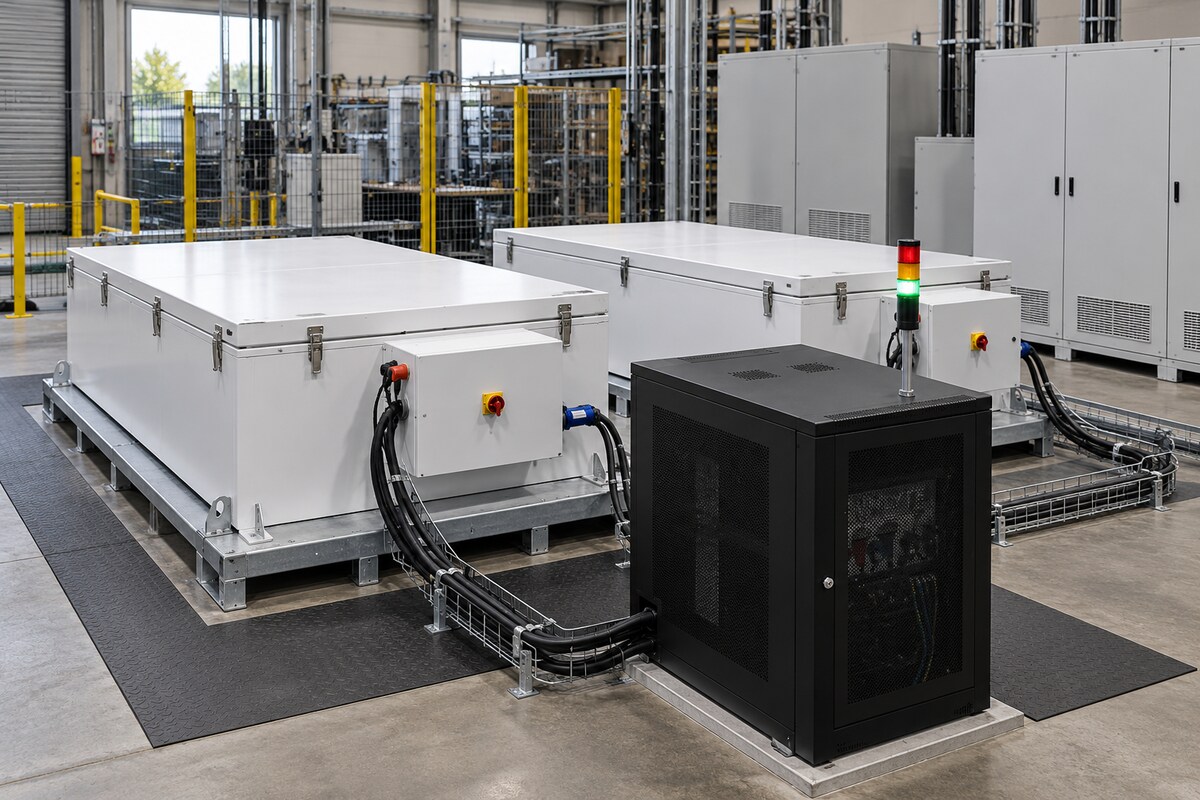
Inlyte completed a factory acceptance test at its facility near Derby in December 2025, witnessed by representatives of Southern Company. The field-ready system combined sodium metal chloride cells with inverter equipment and control electronics. Inlyte reported round-trip efficiency of 83%, including auxiliaries. Its modules could each store more than 300 kilowatt-hours. The factory test assessed performance and integration readiness ahead of an intended installation at Southern Company's Energy Storage Test Site in Wilsonville, Alabama.
Steve Baxley, Southern Company's energy storage and use research and development manager, regarded the test as a step in validating the technology for future applications. He linked the research collaboration to the need for affordable, dependable longer-duration storage. Inlyte's December announcement anticipated field installation in early 2026 and commercial deliveries in 2027, while domestic factory site selection remained in progress. These were distinct milestones: completing a factory acceptance test did not itself establish that the Wilsonville equipment was installed or that an American manufacturing facility had begun commercial production.
A planned resilience microgrid in Sonoma County
In July 2025, Inlyte announced a $4.1 million award from the Department of Energy's Office of Electricity for a project at Alliance Redwoods Conference Grounds in Occidental, California. The site lies in a Tier 3 High Fire Threat Zone and serves as a community evacuation centre and, when needed, a CalFire staging location. The proposed installation would also support a nearby Russian River Utility water pumping station. Vital Energy Solutions would manage development, engineering and construction as the microgrid's lead integrator.
The planned battery system was rated at 200 kilowatts and four megawatt-hours, paired with a proposed 570-kilowatt solar array. Inlyte forecast annual electricity savings of up to $300,000 and emergency backup lasting up to two weeks for the site's intended operation. Those projections concern the planned microgrid and its loads, rather than continuous discharge at the battery's full rated power. EPRI and Pacific Northwest National Laboratory were named as future third-party validation partners. The announcement scheduled the project to become operational in 2027.
A Bern pilot for data-centre operations
Inlyte and NTS Colocation announced a separate partnership on February 26, 2026, beginning with a pilot at an NTS data centre in Bern, Switzerland. Their roadmap called for an initial 600-kilowatt-hour installation, targeted for commissioning at the end of 2026, and deployment of up to two megawatts by 2028. The first figure measures stored energy and the later figure measures power. Successful validation of performance and integration with existing electrical and control infrastructure would precede broader deployment across NTS facilities.
NTS operated data centres in Bern and Zurich and described its existing operations as powered by renewable energy with waste heat recovery. Chief executive Niklaus Hug wanted to assess a further storage layer alongside uninterruptible power supplies and diesel generators. Inlyte proposed combining daily load levelling, extended backup and UPS functions. The Bern pilot would evaluate those capabilities in an operating data-centre environment. Its announced timetable remained prospective as Inlyte worked toward the powder qualification, manufacturing partnerships and American production capacity needed for its planned commercial scale-up.

Leave a comment