
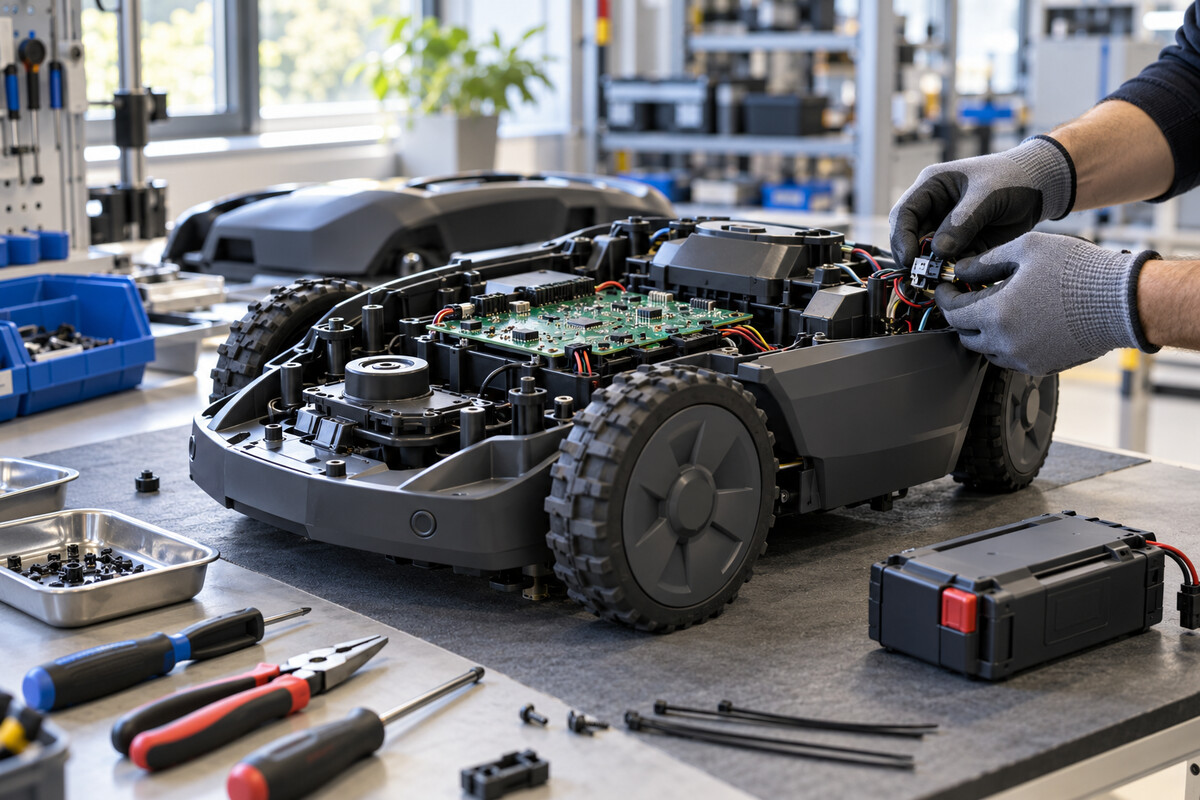
Husqvarna was moving some production from China to European factories and routing some Canada-bound goods away from distribution hubs in the United States in July 2025. CEO Pavel Hajman told Reuters that suppliers were also involved in price negotiations to soften tariff-related cost increases.
About two thirds of its American sales involved imports; Europe supplied roughly half those imports. Currency swings and raw-material costs added pressure. At that time, American tariffs on European Union goods were 10%, with a possible increase to 30% under discussion. Hajman opposed that prospect and urged constructive transatlantic dialogue. Factory closures and a greater focus on watering systems and robotic mowers accompanied the changes. Quarterly robotic mower sales rose 15%, despite intensifying competition from Chinese suppliers.

Restructuring before the tariff changes
Husqvarna’s operating changes preceded the July 2025 trade tensions. On October 20, 2023, the company announced another 300 job cuts while increasing its restructuring savings target from SEK 800 million to SEK 1.2 billion. Full implementation was then expected by 2025. The program directed investment toward robotic mowers, batteries, watering and professional products, while reducing exposure to lower-margin petrol-powered consumer equipment.
Third-quarter 2023 revenue was SEK 10.51 billion, compared with SEK 12.21 billion a year earlier and an LSEG analyst estimate of SEK 11.72 billion. Hajman described delayed orders and inventory reductions amid market uncertainty. Kepler Cheuvreux analyst Johan Eliason considered the gardening season weaker than expected. He associated weaker mower demand in North America with dry weather, while persistent rain elsewhere discouraged irrigation purchases.

Battery systems and connected equipment
Electrified solutions represented 42% of Husqvarna’s motorized-product sales in 2023, up from 34% in 2022. The company’s battery platforms served different applications. Its Aspire garden range used the 18V POWER FOR ALL system, whose alliance Husqvarna Group had established with Bosch in 2020. Users could share a compatible battery and charger across participating manufacturers’ equipment.
The Aspire range launched in 2023 included a robotic mower, walk-behind mower, grass trimmer, pruner, hedge trimmer and leaf blower. Additional tools expanded the range for the 2024 gardening season. In construction, the 94V PACE system supported three power cutters, a core drill and a dust extractor. Connected devices across the group reached 4.5 million in 2023, an increase of 25%.

A further cost program in 2024
On October 23, 2024, Husqvarna announced additional measures expected to reduce annual fixed costs by SEK 500 million and affect 400 positions across the group. The company estimated related one-time costs of SEK 600 million, to be recognized in the fourth quarter. Most of the savings were expected during 2025. Organizational changes remained subject to ongoing negotiations with employee representatives.
The initiative supplemented programs launched in 2022 and 2023. Husqvarna continued to identify robotics, battery-powered products, watering and professional solutions as investment priorities. Hajman presented the fixed-cost reductions as a response to difficult markets and restrained consumer spending, alongside continued investment in the group’s longer-term strategy.

The 2024 sales and inventory position
For 2024, Husqvarna’s net sales totaled SEK 48.352 billion, down from SEK 53.261 billion. Organic sales declined 7%, while planned exits from low-margin petrol-powered activities reduced sales by a further 2%. Operating income excluding items affecting comparability fell to SEK 3.195 billion from SEK 4.970 billion. The corresponding operating margin was 6.6%, compared with 9.3%.
Cost-saving programs generated SEK 735 million during the year. Direct operating cash flow increased to SEK 6.905 billion from SEK 6.541 billion, with inventory reductions contributing to the improvement. Electrified products reached 44% of motorized-product sales, and connected devices reached 4.9 million. Robotic mower sales totaled SEK 7.2 billion, compared with SEK 8.1 billion in 2023. The professional robotics business grew, while residential sales declined amid competition in lower-value segments and restrained consumer spending.

Orangeburg changes ownership
On February 4, 2025, Husqvarna announced an immediately effective partnership with Flex, including the divestment of manufacturing operations in Orangeburg, South Carolina. Flex would manufacture products under a long-term supply agreement. Wheeled-product production and handheld-product assembly for the North American market would continue at the facility. Employees were to be offered employment with Flex.
Husqvarna retained responsibility for product innovation and design. The group expected the arrangement to generate approximately SEK 350 million in cost savings after five years. Related one-time costs booked in the fourth quarter of 2024 were approximately SEK 250 million, with a limited additional charge in the first quarter of 2025. Orangeburg manufactured for the Forest & Garden division. North America, where all three divisions operated, represented approximately one third of group sales in 2024. The divestment changed manufacturing responsibility while preserving the supply relationship.

First-quarter 2025 results
In the first quarter of 2025, Husqvarna’s net sales were SEK 14.704 billion, compared with SEK 14.719 billion a year earlier. Organic sales declined 1%, while exchange-rate movements contributed 1%. Reported operating income fell to SEK 1.532 billion from SEK 1.930 billion. The reported operating margin was 10.4%, against 13.1% in the corresponding quarter.
Excluding items affecting comparability, operating income was SEK 1.561 billion and the margin was 10.6%. Currency movements reduced operating income by SEK 140 million. Hajman attributed the earnings decline primarily to weaker North American performance, currencies and negative price effects, partly offset by cost reductions. Robotic mower sales grew 16%, with contributions from professional and consumer markets. Net debt decreased to SEK 13.7 billion from SEK 17.8 billion. Cash flow from operations and investments was negative SEK 96 million, compared with negative SEK 1.057 billion.

ETwater adds commercial irrigation technology
Husqvarna signed an agreement with Rivulis Irrigation on March 13, 2024, to acquire ETwater. The business was intended to become the nucleus of a new enterprise-customer unit within Orbit, part of the Gardena division. ETwater had ten employees and recorded sales of US$2.6 million in 2023. At announcement, formal completion was expected during March.
Its customers included municipalities, commercial facilities, campuses and large residential communities. Both Orbit’s and ETwater’s systems used data science and predictive analytics, incorporating weather and other environmental variables to create irrigation schedules optimized for individual sites. Gardena president Pär Åström described the combination of ETwater’s technology and the group’s B-hyve capability as an opportunity to expand commercial watering activities in North America. His statement concerned the intended commercial opportunity, alongside Husqvarna’s existing residential watering position.
Professional watering under the Husqvarna name
On May 15, 2025, Husqvarna introduced professional irrigation solutions under the Husqvarna brand. The offering combined Hydro-Rain hardware, ETwater software and B-hyve, which remained the name of the core smart-irrigation technology platform. The company presented the launch as an expansion of its professional offering for North American commercial and agricultural customers.
Husqvarna said the solutions were designed to help customers conserve water, reduce costs and maintain healthy landscapes. Those were product objectives rather than independently measured savings for every installation. The branding brought the hardware and software capabilities together under one customer-facing name, while retaining the B-hyve technology identity. The launch extended the group’s watering portfolio beyond the residential customer base described in its earlier acquisition announcement.
Second-quarter growth and currency effects
Second-quarter 2025 sales increased organically by 5%, although reported net sales decreased 1% to SEK 15.277 billion from SEK 15.430 billion. Exchange-rate movements had a negative 6% effect. Reported operating income increased to SEK 2.063 billion from SEK 1.899 billion, and the reported margin improved to 13.5% from 12.3%.
Excluding items affecting comparability, operating income rose 7% to SEK 2.041 billion, with a 13.4% margin. Cash flow from operations and investments totaled SEK 2.198 billion, compared with SEK 3.459 billion. Direct operating cash flow was SEK 2.357 billion, against SEK 3.917 billion, while net debt decreased to SEK 12.3 billion from SEK 15.6 billion. For the first half, net sales totaled SEK 29.981 billion, compared with SEK 30.150 billion. Organic growth for that six-month period was 2%, distinct from the stronger second-quarter rate.
The next robotic mower range
On October 17, 2025, Husqvarna announced seven robotic mower models featuring AI Vision technology for the 2026 season. New residential models from Gardena and Husqvarna used camera-led navigation for wire-free installation, edge detection and obstacle avoidance. Their stated garden coverage ranged from 400 to 7,500 square metres. The new Husqvarna Automower NERA models included infrared cameras for night-time operation.
For professional customers, the Automower 540 EPOS was intended for facilities of up to 8,000 square metres. A camera accessory scheduled for 2026 would also work with three previously launched camera-ready EPOS models. CEO Glen Instone described the vision technology as a scalable platform for residential and commercial applications. These were manufacturer descriptions of capabilities and compatibility at announcement; the release did not provide independently measured operating results for all customers using the forthcoming range.
A mixed third quarter
Third-quarter 2025 organic sales were flat. Reported net sales fell 5% to SEK 9.204 billion from SEK 9.739 billion, with exchange rates contributing a negative 5%. Reported operating income increased to SEK 141 million from SEK 52 million. Excluding items affecting comparability, operating income was SEK 140 million, compared with SEK 53 million, and the margin improved to 1.5% from 0.5%.
Professional robotic mowers, handheld products and power cutters grew, alongside watering products. Demand for residential handheld equipment, hand tools and petrol-powered wheeled products was subdued, particularly in North America. Residential robotic mower sales declined slightly because of lower Gardena sales. Organic growth was 1% in Forest & Garden and 3% in Construction, while Gardena declined 7%. Net debt decreased to SEK 9.9 billion from SEK 12.8 billion. Instone attributed improved earnings to product mix and cost savings, against tariff and currency pressure.
Brastad’s planned manufacturing exit
Husqvarna announced on October 21, 2025, that it would decommission its Brastad factory. The site employed 84 people and manufactured components for petrol-powered engines used in handheld products. All manufacturing at the facility was to move to third-party suppliers. Production would be phased out gradually, with decommissioning planned for the first half of 2027.
The company expected approximately SEK 100 million in annual savings, with the full effect from 2027. Estimated decommissioning costs totaled approximately SEK 140 million. Of that amount, SEK 20 million was expected as a non-recurring operating charge in the fourth quarter of 2025, with the remainder during 2026. Instone presented the decision as a way to improve cost efficiency and flexibility. The announcement set out a future closure schedule and expected financial effects, rather than confirming completed decommissioning or realized savings.
The 2030 operating framework
At its December 10, 2025, Capital Markets Day in Stockholm, Husqvarna set financial targets for its next strategy period:
- Average annual organic sales growth of 3–5% over a business cycle.
- An operating margin above 10% over a business cycle.
- Return on capital employed of 15% over a business cycle.
The margin and return targets excluded items affecting comparability. Husqvarna reiterated a dividend policy of 40% of net income. A 2026–2030 cost program aimed for SEK 4 billion in annual run-rate savings by the end of 2030. Initiatives covered sourcing, the geographical manufacturing footprint, product platforms and organizational efficiency. Expected non-recurring costs totaled SEK 1.5 billion across the period: approximately SEK 0.5 billion in non-cash items and SEK 1 billion affecting cash flow. These were company targets and expected program costs, with implementation timing to be communicated as major activities progressed.
The full-year 2025 outcome
Husqvarna’s final 2025 results, published on February 4, 2026, recorded net sales of SEK 46.613 billion, down from SEK 48.352 billion. Organic growth was 1%, while exchange-rate movements had a negative 5% effect. Reported operating income increased to SEK 2.898 billion from SEK 2.597 billion, and the reported margin rose to 6.2% from 5.4%.
Excluding items affecting comparability, however, operating income decreased to SEK 2.901 billion from SEK 3.195 billion; the corresponding margin fell to 6.2% from 6.6%. Fourth-quarter net sales were SEK 7.429 billion, against SEK 8.464 billion, with organic sales down 3%. The reported quarterly operating loss was SEK 837 million, while the loss excluding comparability items was SEK 841 million. Net debt at year-end decreased to SEK 11.8 billion from SEK 14.5 billion.
First-quarter 2026 execution
In the first quarter of 2026, Husqvarna recorded 2% organic sales growth. Reported sales nevertheless declined 5% to SEK 13.962 billion from SEK 14.704 billion, including a negative 7% currency effect. Reported operating income reached SEK 1.710 billion, while operating income excluding comparability items was SEK 1.718 billion. The operating margin was 12.3% on either basis.
The company reported approximately SEK 245 million in quarterly savings from initiatives including lower-cost sourcing, design simplification and reduced complexity. It was also establishing Business Portfolio Units to sharpen accountability and performance management. Net debt was SEK 13.8 billion, compared with SEK 13.7 billion. Free operating cash flow was negative SEK 1.137 billion, against negative SEK 131 million. From that quarter, this alternative performance measure replaced direct operating cash flow. Its comparative figures therefore belong to the newly presented free-operating-cash-flow measure.

Leave a comment