
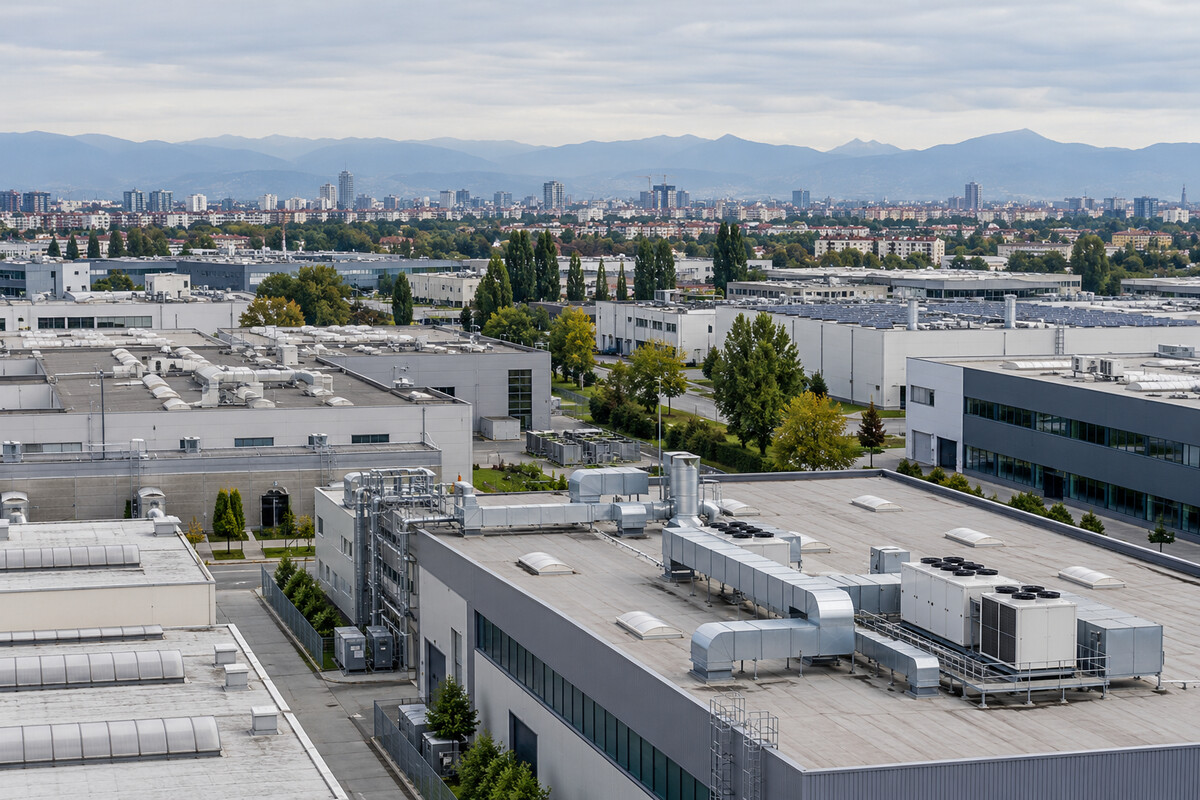
From production controls to recovered materials
Factory digital twins, autonomous building controls and visual waste identification featured at Climate Week NYC’s September 2026 panel on efficiency, electrification and AI. Mike Peirce, Climate Group’s executive director of systems change, moderated speakers from Unilever, Trane Technologies, the Ellen MacArthur Foundation and the Energy Efficiency Movement.
Hannah Hislop, Unilever’s head of sustainability for climate, argued that efficient manufacturing, electrification, renewable energy and lower-emission products would strengthen future competitiveness. Emily Vesling, Trane’s director of sustainability, emphasised applying AI controls over existing equipment. Danielle Holly, the foundation’s executive lead for North America, connected data transparency and predictive analytics with understanding circular business models.

The climate risks behind the efficiency discussion
Global warming is likely to exceed 1.5°C above pre-industrial levels within the next few years, UNEP projected on 2 September 2026. Its Limiting Overshoot assessment examined a pathway that restricts the peak, shortens the period above that threshold and subsequently brings temperatures down. The most optimistic scenario still peaked at 1.8°C; most other scenarios reached higher temperatures. Infrastructure, water supplies, cities and economies were among the areas exposed to intensifying impacts.
UNEP called for sustained emissions reductions alongside adaptation to changing risks. It treated net zero as a milestone towards net-negative emissions, with carefully governed carbon removal supplementing continued cuts. The assessment also warned of irreversible losses even if temperatures eventually return below 1.5°C. Its pathway therefore combines reducing future warming with preparing for damage and disruption that cannot all be avoided. Those projections provide the wider risk context for industrial energy management.
Energy and water costs have a longer history
Unilever had avoided around €1.5 billion in costs through energy and water efficiency measures since 2008, the company stated in September 2023. That cumulative figure covered both resources and a programme extending across many years. It was not presented as an annual return from artificial intelligence.

The company associated operational efficiency with changes to manufacturing processes and supply chains, including smarter energy use, water conservation and fewer journeys. It also placed collaboration within its sustainability strategy because much of its environmental footprint occurred outside its own operations. These were Unilever’s business arguments for its approach, alongside the historical cost-avoidance figure.
Digital production lines before the latest rollout
Unilever was already using Azure IoT digital-twin technology to represent physical production lines at its Valinhos Dove factory in Brazil in July 2019. Dave Penrith, then the company’s chief engineer, demonstrated the approach with Microsoft at its Inspire event. Unilever was also developing PowerApps and Power BI applications to use real-time data insights. The digital representation of production equipment and those applications formed part of an earlier effort to digitise its supply-chain network, years before the June 2026 expansion announcement.
What a manufacturing digital twin must represent
Digital twins are synchronised virtual models that can represent, diagnose, predict and optimise operations. NIST’s advanced-manufacturing programme addresses the technical work needed to make those models reliable. Common vocabulary, interoperability, trustworthy results and procedures for verification and validation remain implementation challenges, particularly for smaller manufacturers. A model also needs appropriate data and an account of uncertainty in its results.

By July 2026, NIST’s programme combined implementation methods, standards development and testing with a digital-twin testbed. Planned products included reference architectures, reference implementations and methods for verification, validation and uncertainty quantification. Lifecycle integration would connect design, production and maintenance through digital threads. ISO 23247, the manufacturing digital-twin framework, was published in 2021. Further work included a proposed verification and uncertainty framework and implementations addressing digital-thread data flows. These were research and standardisation activities intended to improve model credibility and traceability, with testbeds supplying feedback to standards developers.
A collaboration starting with an AI laboratory
Unilever and Accenture announced a next-generation AI collaboration on 5 December 2023, starting at Unilever’s recently opened Horizon3 Labs in Toronto, Canada. Their planned exploration included Accenture’s AI Navigator and a model-selection system described as a switchboard, allowing combinations of models to suit a business context. Productivity, efficiency and the wider scaling of AI applications were among the stated aims.
Julie Sweet, then Accenture’s chair and chief executive, linked the initiative to a relationship lasting more than three decades. Steve McCrystal, Unilever’s chief enterprise and technology officer at the time, described the laboratory as a platform for collaboration with Accenture and other partners. The initiative would use capabilities from Accenture’s previously announced $3 billion investment in data and AI. That was the consultancy’s broader investment programme, rather than a disclosed price for the Unilever collaboration. Its experts and ecosystem relationships were also part of the proposed support.

Five factory applications and a further expansion
Unilever’s June 2026 rollout announcement set out plans for more than 40 new digital twins over the following 18 months. Accenture would support analytics and AI agents, with some adjustments becoming automatic as systems learned and employees gained confidence, under human oversight. Existing sites illustrated different applications:
- Raeford, North Carolina, in the United States: 95% of deodorant-stick process restrictions predicted, 20% less waste and 10% more capacity.
- Haldia, India: fan, temperature and moisture controls supporting lower thermal energy consumption over two years.
- Poznan, Poland: mayonnaise viscosity stabilisation, up to 20% fewer minor stoppages and nearly 30% less waste.
- Gandhidham, India: quality defects down 30% over four years, measured at distribution centres before delivery.
- Cu Chi, Vietnam: intelligent mixing saving 1–2% of premium ingredients through optimised dosing.
Those were company-reported results for particular processes and measurement points. The additional twins remained a deployment plan, building on applications already operating across the manufacturing network.
A boiler twin alongside a change in fuel
Sonepat, Unilever’s largest Horlicks manufacturing site, began its digital transformation after joining the company’s manufacturing network in 2020. By December 2023, Unilever attributed a 30% reduction in food waste to real-time monitoring and precision control. It also reported an 86% reduction in product defects, partly through automated production with minimal human intervention and advanced data capture.
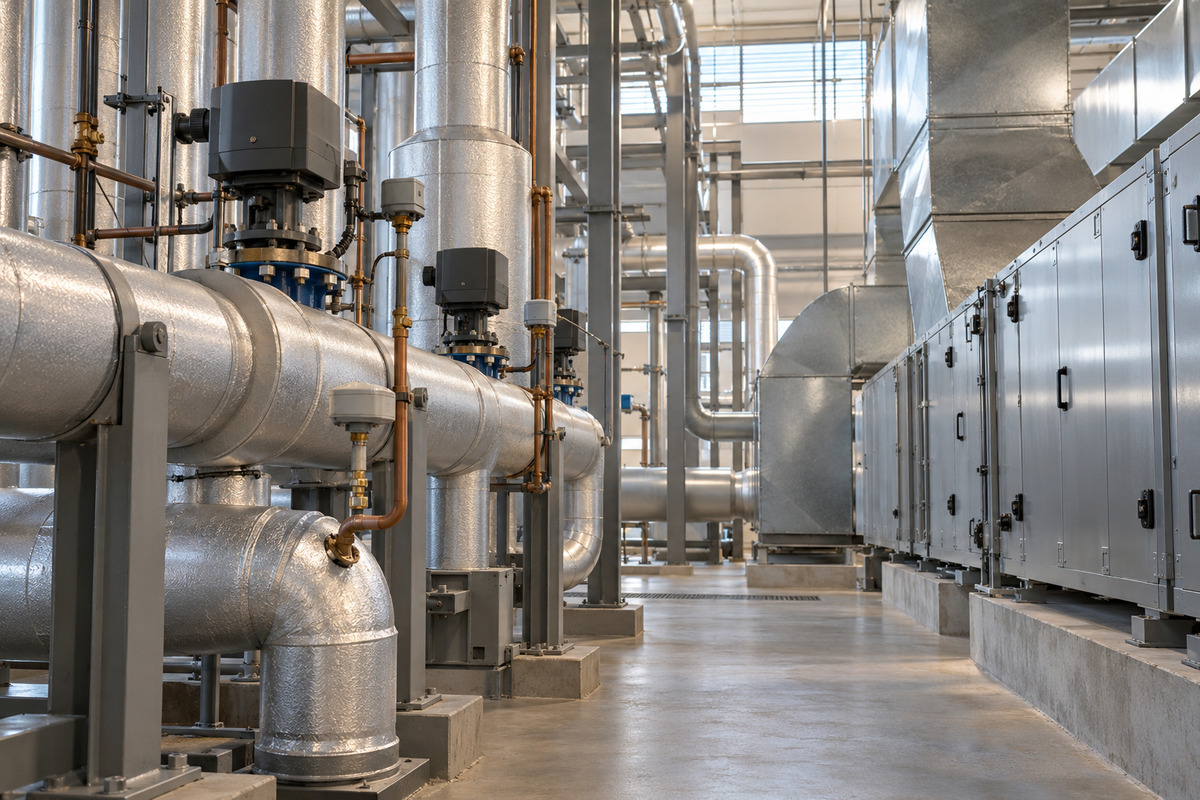
The factory’s energy work combined sustainably sourced biofuels with a boiler digital twin that optimised operating performance and energy use. Together, those changes reduced its direct, Scope 1 greenhouse-gas emissions by 88%, according to Unilever. Agricultural waste also provided a fuel outlet benefiting local farmers. The result therefore involved a fuel change as well as a digital model. Workforce development accompanied the equipment changes: all team members completed an upskilling programme. Factory director Abhishek Jain described its learning mix as 70% on the job, 20% mentoring and coaching, and 10% classroom instruction, including safety modules using AI and augmented virtual reality.
Packaging trials and shorter planning cycles
At Tinsukia, an AI-enabled digital twin supported packaging trials by allowing teams to simulate and test changes before implementing successful options. Unilever reported in January 2025 that the site had reduced virgin plastic in its packaging by 21%. Packaging-trial time had fallen by 84%, with the number of trials increasing from two in 2019 to 30 in 2023. The company’s separate ambition was to reduce virgin plastic across Unilever by 40% by 2028.
The factory also used a digital planning system capable of analysing more than 10,000 product combinations through over 300 features. Its frozen planning period—the interval for planning and resetting production schedules—fell from 14 days to one, a reported 92% reduction. Unilever linked the change with faster responses to demand and more efficient stock replenishment. Employees were part of the transformation: the factory leader said 23% of the workforce had been redeployed to lead digital changes, with engineers receiving training to develop new capabilities on the shop floor.

Autonomous controls join Trane’s building systems
Trane Technologies completed its acquisition of BrainBox AI on 3 January 2025, following the announcement on 18 December 2024. The transaction extended an existing collaboration between the companies. BrainBox AI, founded in 2017 and headquartered in Montreal, developed autonomous heating, ventilation and air-conditioning controls using deep-learning algorithms to predict building energy needs and automate equipment operation.
Trane associated the technology with reductions of up to 25% in energy consumption and up to 40% in greenhouse-gas emissions. Those were the company’s stated upper-end capabilities, with no claim that each factory would achieve them. Its building customers spanned offices, hotels, retail properties, grocery stores and airports. Riaz Raihan, Trane’s senior vice president and chief digital officer, described the acquisition as combining complementary technology and digital capabilities. The completed purchase brought the supplier into Trane’s business while extending their earlier work on autonomous building solutions.
Controls installed over an existing building system
BrainBox AI operated through an existing building management system at La Forgiatura, a business park in Milan. Initial installation and training began in late 2021, followed by full operation in February 2022. R2M Solution and BrainBox AI worked with RealStep and facility managers on the implementation. Nine buildings were under full or partial AI control by October 2024, according to the project partners in REHVA Journal.

Two algorithms handled different tasks. Optimus adjusted HVAC start and stop times using predicted temperatures and operating conditions. Water-Clock varied heating and cooling delivery temperatures against forecast weather and thermal loads. Facility managers could disable the algorithms for maintenance and restore them afterwards. The authors reported aggregate savings of 183,300 kWh, or 26.1%, on the equipment under AI control, with an economic value of €45,775, over February 2022 to August 2024. Additional reductions in thermal demand were outside those figures. The case concerned controlled equipment within that installation, with autonomous operation expanding over time.
Shifting HVAC demand during renewable surpluses
A Chicago building at Loyola University tested a different control objective: matching HVAC demand to periods when renewable electricity would otherwise be curtailed. BrainBox AI’s automated emissions reduction algorithm used WattTime’s Marginal Operating Emissions Rate signal alongside its HVAC optimisation system. The collaboration also involved the University of California, Berkeley’s Center for the Built Environment and support from the Great Lakes Protection Fund.
The building’s thermal capacity allowed energy demand to move between periods, functioning as thermal storage. A year-long randomised trial compared three building-management modes in the ten-storey, 150,000-square-foot building. BrainBox AI reported the results in May 2024: 10% annual reductions in HVAC-related energy costs and emissions, and emissions reductions of up to 15% during renewable curtailment and the four hours afterwards. Those figures concerned HVAC operation in the trial. The project had been announced in March 2021, with its results recognised in 2023.
Identifying waste by material and object form
CircularNet’s technical design addresses the difficult visual conditions inside material recovery facilities. Waste streams contain overlapping objects, variable shapes and textures, deformation and fine distinctions such as paper versus cardboard or flexible versus rigid plastic. Google’s TensorFlow team introduced the model family in October 2022 to identify recyclable materials and contamination within those streams.
The models used Mask R-CNN instance segmentation, which identifies individual objects within an image. Their annotations distinguished material types, object forms and plastic categories: a bottle could be characterised by its form, its plastic material and a more specific polymer category. Training involved real facility imagery, removal of incorrect labels and corrupt images, and conversion of cleaned annotations into a training format. Separate models served different classification purposes. Server and edge-device deployment formats supported different operating settings. Google made the models and processing guides available for others to adapt and improve. Further industry partnerships were intended to expand the variety of waste streams represented in training.
Cameras and traceable collections in India
Recykal applied CircularNet in its Indian waste-commerce operations. In September 2023, the Hyderabad company reported detection accuracy exceeding 90% for categories including metals, bottles, tubes, cutlery and several plastics. It separately reported a 60% improvement in measured production quality. Detection accuracy and production quality were different measures, each attributed to the company’s implementation.

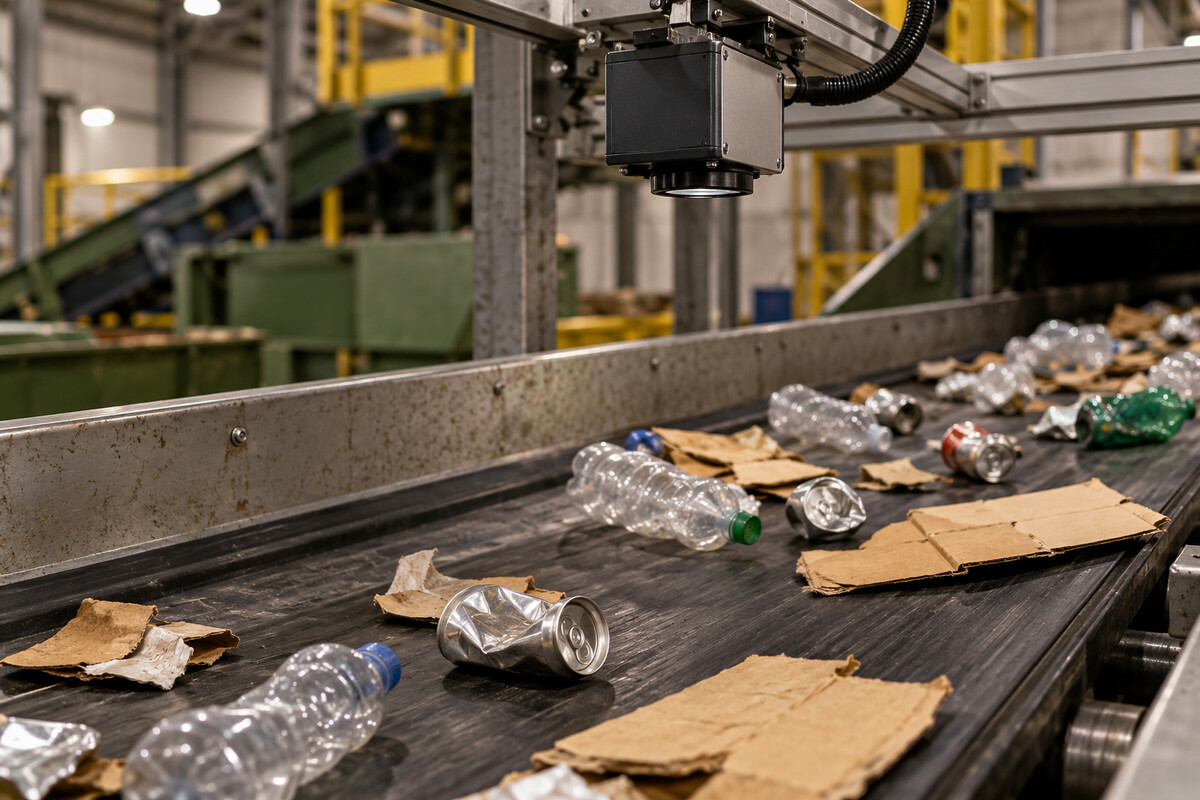
Almost 13,000 households had received recycling bags carrying unique identifiers. Weekly collections went to smart centres and material recovery facilities, where cameras scanned material emptied onto conveyor belts. Images captured at processing points generated information about materials and contamination, helping operators and other stakeholders understand the waste stream. Recykal’s marketplace handled plastic, paper, metals, electronic waste and batteries. The company then said it diverted 50,000 metric tonnes from landfill each month. That was a dated company claim within the 2023 case study. Its digital system connected collection information, visual identification and a marketplace through which recovered materials could reach buyers.
The circular-economy research behind the applications
The Ellen MacArthur Foundation’s 2019 research with Google, supported analytically by McKinsey, considered AI across product design, operations and infrastructure optimisation. It examined food and consumer-electronics value chains as initial cases. The work estimated potential annual value in 2030 of up to $127 billion for food and up to $90 billion for consumer electronics through applications helping to design out waste. Those estimates were prospective opportunities, rather than returns already earned by the later factory or recycling installations.
At Climate Week, Holly anticipated more collaboration around secondary critical-mineral supplies as companies faced constraints. She also cited sorting-efficiency improvements from 15% to 80% for some models, without specifying a common benchmark. Her comments described opportunities and expectations, alongside the particular operating examples and plans discussed by the panel.

Leave a comment