

Funding for circular manufacturing
The Department of Energy offered $33 million for smart-manufacturing research in July 2024, with circular supply chains among four priorities. The programme, overseen by the Advanced Materials and Manufacturing Technologies Office, also covered tooling and equipment for sustainable transportation, high-performance materials and sustainable mining. The materials priority included high-conductivity components involving nickel and copper. In the United States, the circular work included recovering materials and extending the useful lives of manufactured products through repair, remanufacturing and other routes.
The application timetable called for concept papers by 22 August 2024 and complete submissions by 18 November 2024. Awards were expected to begin the following spring. Circularity research included better identification and sorting of recoverable materials, alongside open, interoperable supply chains for products not originally designed for reuse. A separate competition had already recognised 20 teams in June 2024, each receiving $50,000 for innovations supporting reuse, repair, refurbishment, remanufacturing or repurposing.
Three connected areas of research
DOE issued funding opportunity DE-FOA-0003329 on 18 July 2024. Its definition of smart manufacturing included digitalisation and artificial intelligence used to improve productivity, quality assurance and security. The circular-economy topic divided the work into three areas:

- Identification, sorting and characterisation technologies that help recover materials for manufacturing new products.
- Interoperable, open supply chains that make additional products suitable for repair, remanufacturing and other life-extension pathways.
- More available and transparent data for accurate life-cycle assessments and greater market acceptance of secondary materials.
The same opportunity covered automation and asset management for transportation-manufacturing equipment, discovery and scale-up of high-performance materials, and sensing and analytics for domestic mining. Sustainable transportation included battery-electric and fuel-cell vehicles, from automobiles to fleets and trucks. Its timetable anticipated selection notifications in April 2025 and award negotiations during April–June 2025. Those dates were expectations attached to the application process, rather than confirmation that particular projects had received funds or reached production.
Product life before material recycling
DOE launched the Re-X Before Recycling Prize on 27 November 2023 to develop supply chains that retain products or components through reuse, repair, refurbishment, remanufacturing and repurposing before recycling. The competition offered a $4.5 million cash pool, with a separate $1.1 million for national-laboratory consultation and technical assistance. AMMTO led the programme, which the National Renewable Energy Laboratory managed. The support combined development money with access to analysis, rather than consisting entirely of cash payments to competitors.
Three phases separated identifying an opportunity from putting it into practice. Identify asked teams to propose an innovation and a development plan. Prepare involved refining that plan, drawing on laboratory expertise and building networks of mentors and partners; new competitors could also enter this phase. Develop required execution, progress towards implementation and a plan for continuing after the competition. The first phase originally offered up to 20 awards of $50,000, plus laboratory consultation worth up to $5,000 for each winner. Applications were initially due by 5 p.m. Eastern Standard Time on 12 March 2024.

The next phase funded preparation
Ten teams from seven states and Washington, D.C., became Phase 2 winners on 14 January 2025. The collective cash award was $1.5 million: $150,000 for each team, alongside up to $100,000 apiece in national-laboratory technical assistance. Their projects involved goods including furniture, home products, automotive headlights and food-service items. Winners included Baby Gear Group, Doors Unhinged, Lifecycle Building Center, Llink Technologies, Revise Robotics and Smartville. During preparation, competitors had used expert analysis, refined their supply-chain plans and developed relationships with mentors and partners to support implementation and potential community benefits.
The third phase opened to returning competitors, with submissions then due by 5 p.m. Eastern Time on 8 December 2025. Teams would need to demonstrate substantial progress towards a viable Re-X supply chain, engage their communities and develop an actionable continuation plan. The intended benefits included lower life-cycle energy use and emissions, stronger circular supply chains and less demand for virgin materials. These were programme objectives for the selected projects; the January announcement did not establish measured environmental results for every team.
Automotive lighting needs a return channel
Llink Technologies in Brown City, Michigan, was developing a larger core-return processing service for automotive lighting assemblies in January 2025. Used assemblies entering remanufacturing are the cores on which this activity depends. The company associated its development work with reducing processing costs for original equipment manufacturers, increasing the eligibility of returned cores and protecting patented lighting designs. Its existing headlight programme was also expanding towards other assemblies, including taillights, while it worked to establish participation by international vehicle manufacturers.
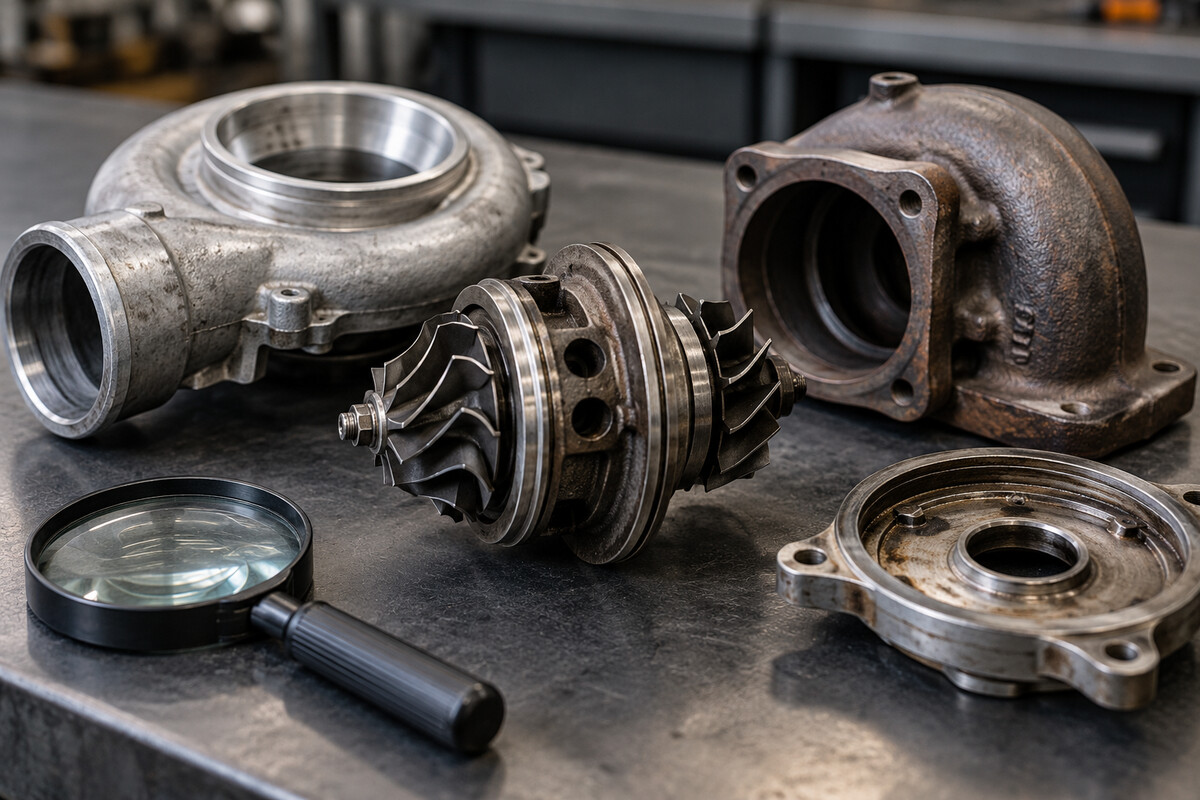
The large-scale return-processing service was scheduled to launch during 2025. Llink linked it to a wider effort to expand its circular supply chain, following recognition in the first two phases of the Re-X competition. Original equipment manufacturers were the intended participants in the international expansion. The planned service would process returned assemblies, while the wider remanufacturing programme was extending the range of lighting products that could enter its supply chain. Its January 2025 development plans therefore covered both product range and the organisation of returns.
Inspection determines what can be retained
Cummins' ReCon process includes disassembly, inspection, cleaning, calibration and testing against the performance requirements of new Cummins parts. Cleaning methods include lasers for rust and enzymes for grease and oil. Ultrasonic inspection helps examine cleaned components. When an original design has received an engineering upgrade, that change is incorporated during remanufacturing. The resulting parts can be sold individually or assembled into ReCon engines, following examination of their separate components.
Almost 85% of an engine can be remanufactured, according to Cummins' January 2024 explanation. Eligible parts range from turbochargers and fuel pumps to injectors, actuators and cylinder heads. Components with a predetermined lifespan, or with fatigue that is difficult to detect, are excluded and replaced. Reassembled engines were painted and tested at Cummins facilities, with zero operating hours or miles and a ReCon or new-parts warranty. Cummins also identified supplier coordination as a challenge: designing for another life requires collaboration over manufacturing requirements and recovery principles. Its tools had expanded to include additive manufacturing and collaborative robots alongside newer cleaning methods.

A remanufacturing business at Flins
Renault Group's automotive-parts remanufacturing activity at the Flins Refactory in France joined The Future Is NEUTRAL under the name THE REMAKERS on 2 May 2024. Its expertise dated to 1949. The business offered nine families of components covering more than 11,000 references, with a mixture of refurbished and new parts used to restore original-part quality. Renault positioned the activity to serve the wider automotive industry as part of its circular-economy operations.
The range spanned mechanical products such as engines, gearboxes, turbochargers and injectors; electrical products including motors and power-electronics boxes; and electronic products such as multimedia systems. Renault put the average customer price at 30% below that of a new part. The business targeted 50% growth by 2030 and intended to expand its portfolio and partnerships. A €500 million investment plan through 2030 covered The Future Is NEUTRAL's broader existing and new businesses. That group-level plan was distinct from the growth target for THE REMAKERS alone.
A separate loop for shared bicycles
Valeo and Smovengo developed a repair and remanufacturing partnership for the 8,000 electric Vélib' bicycles operating around Greater Paris. Valeo's May 2024 programme assigned battery repairs to its Circular Electronics Laboratory in Nevers and motor remanufacturing to its Circular Innovation Factory in Czechowice, Poland. The partnership separated the battery and motor work between specialised sites, while extending Valeo's circular activities beyond passenger cars and heavy-duty vehicles into shared electric bicycles.
The Czechowice motor line opened in less than six months, with an initial capacity of up to 5,000 motors a year. Valeo expected to triple that capacity over the next three years. The capacity figure described the line's initial capability, while 8,000 described the associated bicycle fleet; neither figure was an annual count of completed remanufacturing jobs. Valeo also operated a worldwide remanufacturing competence centre at Czechowice and had launched a high-voltage prototype laboratory there in 2023. Across its wider remanufacturing portfolio, Valeo then processed around one million parts annually, marketed through more than 8,000 references. Its electronics laboratory had launched a remanufactured windshield camera with Stellantis in 2023.
Collection, sorting and core credits
Valeo's April 2025 arrangements addressed the distributor's side of core management. The company handled collection according to demand, with a minimum of 20 units and one transport company collecting cores within each country. At the plants, its e-Corps tool supported sorting. Credit notes were issued within 48–72 hours through that processing arrangement. Each remanufactured product type also had a single core surcharge value, simplifying the calculations and sorting that distributors previously needed to manage across returned parts.
The collection work accompanied an expanding electronics portfolio. Valeo and Stellantis introduced a remanufactured LED headlamp in the SUSTAINera REMAN range. Valeo's internal estimates put reused raw materials at up to 50% and carbon-dioxide emissions at up to 70% below production of a new headlamp. Other developments included display screens and a Renault Zoe inverter remanufactured at Veszprem, Hungary, then integrated into a power-control module at Flins. The inverter offer was scheduled for the Renault network in the second half of 2025.

Spare components keep a packaging line running
Normandise Pet Food in Vire, Normandy, used Bosch Rexroth's REMAN service to overhaul 25 motors and drive units on packaging equipment that was around 20 years old. Identical spare components maintained production while the original units underwent remanufacturing at a Bosch Rexroth competence centre. The work involved comprehensive checks, preventive replacement of wearing parts and technological updates where possible. The service enabled the company to retain its existing packaging machinery while renewing the components that supported its automated operation.
Bosch Rexroth reported an installation stoppage of 15 minutes and savings of 50% compared with replacement in July 2025. Normandise estimated an hour of downtime at €8,000. That hourly estimate described the company's production constraints; it was separate from the reported cost comparison for the intervention. The company, founded in 1991, processed 150 tonnes of meat daily into pet food. After the initial work, it planned further REMAN projects on two additional production lines during 2025, rather than announcing those projects as completed.
Reusable products also need washing logistics
StopWaste's Back to Reusables project in Alameda County, California, connected product reuse with collection and washing infrastructure. By February 2025, 26 county schools had adopted reusable foodware systems. StopWaste and the Center for Environmental Health planned to compare three models: washing and restocking at each campus, collecting foodware for a central district dishwasher, and hiring an outside washing service to collect, clean and return it. The work would document costs, processes and employment associated with the different arrangements.

The project scope called for a national-laboratory techno-economic analysis, including capital and operating costs. A planned toolkit would combine that analysis with life-cycle assessment results, case-study insights and supplier information for foodware, dishwashers and washing services. Outreach aimed to reach 300 schools across the country. These were planned deliverables in a February 2025 board proposal for accepting the Re-X prize. The proposal also envisaged grants and technical assistance to help additional Alameda County districts meet upfront transition costs.
Recovery decisions begin in product design
NIST's Data-Driven Design for Product Recovery project addresses decisions made before products enter service. Its programme, created in April 2024 and updated in September 2026, develops standards, metrics and computational methods for evaluating recovery pathways during early design. The work focuses on complex architectures in batteries and energy storage, consumer electronics and microelectronics, including integrated circuits. Case studies, reference models and measurement methods are intended to connect engineering choices with later reuse, refurbishment and material recovery.
The research combines systems approaches with optimisation, machine learning and natural-language processing to support design decisions. Planned metric databases and process models would help stakeholders exchange information across a product's life cycle and value chain. Validation through case studies and pilots forms part of the work. A lithium-based traction-battery recovery information model supports data coordination and end-of-life planning. NIST also listed publication of ASTM E3461-25, a guide to principles of circular product design, among its later highlights. Those developments belong to the subsequent work on recovery methods, following the July 2024 funding announcement.

A framework for priorities and measurement
DOE opened a consultation on a draft strategic framework for products and materials circularity on 9 October 2024. The first version brought together current Office of Energy Efficiency and Renewable Energy activities and areas for future support. Industry, universities, research laboratories, government agencies and other stakeholders were invited to contribute. Responses were due by 5 p.m. Eastern Time on 16 December 2024. The consultation addressed opportunities and difficulties in recirculating products and materials, alongside the development and deployment of relevant technologies.
The requested feedback covered research priorities for energy efficiency, supply-chain security, community benefits and manufacturing competitiveness. It also addressed business models, the policy landscape and the data needed to prioritise activity and measure progress. DOE associated recirculation with reduced demand for extraction and manufacturing energy, improved material efficiency and more resilient supplies. The framework remained a draft seeking stakeholder input at that stage. It proposed a way of coordinating research and engagement across product and material pathways, rather than announcing another completed manufacturing installation or an allocation to every proposed project.



Leave a comment