
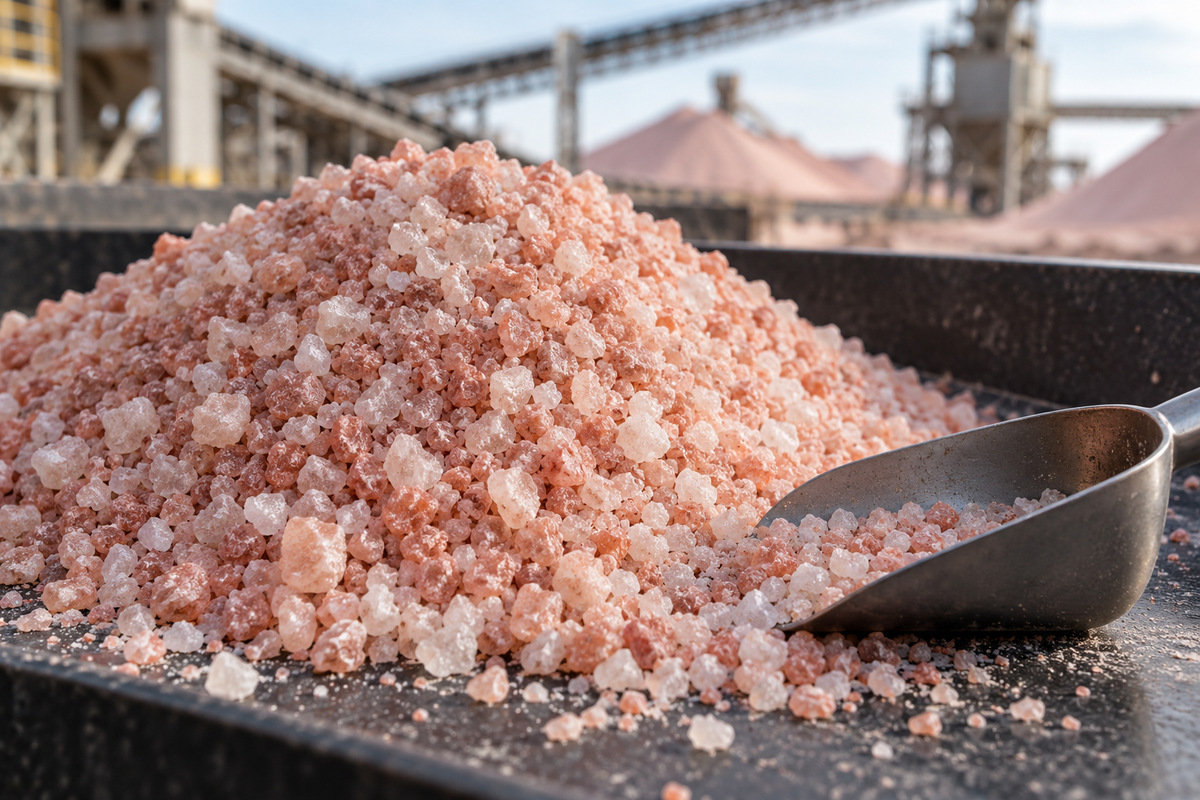
Investment and the first production schedule
BHP raised the estimated cost of Jansen Stage 1 to US$7 billion–US$7.4 billion in July 2025, compared with its original US$5.7 billion budget. First production at the potash project in Canada moved from the accelerated target of late 2026 to mid-2027. Higher costs, changes in design and scope, and weaker productivity contributed to the increase. BHP was also considering moving Stage 2's first production back two years, to fiscal 2031, because additional potash supply could enter the market. Jefferies analysts viewed the higher capital expenditure guidance negatively, while recognising BHP's strong quarterly operations. The miner achieved record copper and Western Australian iron ore production in fiscal 2025 as it continued developing potash alongside its established businesses.
Jansen's development involved neighbouring communities well before the revised budget. By January 2023, municipal, First Nations and Métis representatives and local organisations had visited the Saskatchewan site after pandemic restrictions had been revised. Their programme combined a walk through Discovery Lodge, a virtual reality introduction to the mining systems and thousand-metre-deep shaft, and a bus tour of surface construction. Simon Thomas, then President Potash, emphasised BHP's relationships across Saskatchewan and Canada. Darin Pedersen, reeve of the Rural Municipality of Prairie Rose No. 309, returned after five years and welcomed the visible construction progress. Participants discussed employment and contracting pathways as well as the development programme. The visit covered both accommodation and mine infrastructure, with many guests seeing the site for the first time.

Three contracts announced in March 2023 covered camp management, site services and foundations for raw ore handling. Together, their value exceeded C$260 million over three and a half years. BHP anticipated more than 400 local jobs, with over half intended for Indigenous workers. Wicehtowak Frontec Services, a partnership between ATCO Frontec and George Gordon Developments, received the camp contract; its ownership had evolved to a majority Indigenous position. The other two packages went to 2Nations Bird, bringing together Bird Construction, Willow Cree Developments and Fishing Lake First Nation's FLFN Ventures. Its work would involve KDM Constructors and George Gordon Developments. KDM represented Kawakatoose, Day Star and Muskowekwan Nations. BHP's Chief Commercial Officer Vandita Pant linked these awards to the company's intention to build long-term relationships with Indigenous suppliers.
BHP approved US$4.9 billion for Jansen Stage 2 on Oct 31, 2023. Chief Executive Officer Mike Henry described the expansion as part of the company's growth in potash and its expectation of long-term value for shareholders and local communities. At approval, BHP expected first production in fiscal 2029, followed by a three-year ramp-up. That was the expansion's original timetable, before subsequent revisions. The investment included more storage at Westshore Terminals in Delta, British Columbia; BHP had deferred a formal port-capacity extension decision. Its construction scope covered several parts of the mine and export chain:
- Additional underground mining districts.
- Completion of infrastructure for the second shaft hoist.
- Expanded processing facilities and additional rail cars.

Power and construction partnerships
Jansen's 230-kilovolt substation was commissioned in February 2024, replacing reliance on a temporary SaskPower feed for the next stage of mine development. Electricity was needed for mineral processing, material movements, ventilation, lighting and auxiliary services. Sabri Hamida, Area Manager for Port and Non-Process Infrastructure, connected the change to approaching milestones such as hoist commissioning and underground development. Deputy Commissioning Manager Arlene Baquiran explained that the substation was the point where secured electricity first entered the site and would support later stages as well as Stage 1. Environmental staff reviewed the habitat before the land disturbance. With the high-voltage installation commissioned, the team turned to energising the 34.5-kilovolt substation. That remained the next task in BHP's March 2024 construction update.
The project's engineering workforce included recent university graduates. Yasmin Adem completed a Bachelor of Applied Science in Mechanical Engineering at the University of Toronto in 2022 and was working as a BHP graduate engineer at Jansen by May 2024. For Adem, joining the project near the beginning offered an opportunity to participate in development through to eventual production. She described support from her immediate team, the site community and BWISE, BHP's employee resource group for women. Her account connected workforce inclusion with the ability to contribute different perspectives and ideas within a team. The graduate route formed one part of recruitment for the new potash business, alongside the separate vocational programmes later developed for operational and maintenance roles.

George Gordon Developments and Aecon formed Wicehtowak Aecon Industrial Limited Partnership to deliver the Stage 1 wet mill area. BHP announced the award on Jun 5, 2024, when overall construction was 44% complete. The partnership would install preassembled units for the wet mill, tailings and reagents buildings; fabrication at an Aecon facility in Alberta was covered by an earlier contract. George Gordon Developments is owned by George Gordon First Nation, one of six local First Nations with BHP Opportunity Agreements. Those arrangements address employment, procurement, environmental management and social investment. The award brought BHP's Indigenous business contracts since Stage 1 approval to more than C$850 million. George Gordon Developments CEO Don Ross emphasised economic opportunities for the Nation, while Potash Asset President Karina Gistelinck welcomed the partnership.
By July 2024, construction had passed the halfway point for Stage 1, with Stage 2 also under way. The remaining programme included the mill building, processing plant, port works and other infrastructure, followed by transfer to the operations team. Workforce preparation was therefore progressing alongside physical construction. BHP acknowledged logistical difficulties, harsh weather and competition for labour during the work. Programme Director Christoff Kühn credited the project team with more than 9.7 million exposure hours since sanction without a fatality or critical incident, a safety record reported at that stage of construction. Karina Gistelinck highlighted contributions from contractors, procurement partners and neighbouring communities. BHP still targeted first production in 2026 at that point; the later schedule revision had yet to be announced.

Underground machinery and hoisting
Sandvik's Stage 2 underground mining equipment contract, announced by BHP in September 2024, was valued at approximately C$280 million for two mining systems. The equipment combined large automated borers with extendable belt conveyors. BHP and Sandvik had collaborated for several years on equipment and automation suited to Jansen, testing a prototype in underground salt mines in Germany. BHP expected each system to provide output comparable to three systems at other mines, a company performance expectation rather than a measured production result at Jansen. Simon Thomas, by then Vice President Projects Potash, anticipated improvements in efficiency and safety. Mats Eriksson, President of Sandvik Mining and Rock Solutions, welcomed the continuation of the companies' collaboration through equipment supply for the expansion.
ABB and BHP signed a multiyear global framework agreement in October 2024, extending a relationship that already included equipment and technology for Jansen. The agreement provided for further collaboration in project delivery, operations and maintenance, together with work supporting BHP's operational decarbonisation ambitions. It applied across the company's global portfolio rather than exclusively to the Canadian mine. BHP's commercial and procurement executives Rag Udd and Rashpal Bhatti presented the arrangement as a way to strengthen that continuing relationship. ABB Process Industries President Joachim Braun similarly emphasised technology deployment, productivity and safety. The framework established a basis for cooperation; its announcement did not establish completion of Jansen's individual equipment packages or provide a mine-specific reduction in emissions.

ABB's separate December 2024 hoisting announcement specified three friction hoists and an electrical system for a Blair service hoist. One production hoist was designed for 75-tonne payloads, supported by six ropes and two 7,700-kilowatt motors. Its specified maximum speed was 18.3 metres per second over a lift from approximately one kilometre underground. Installation of the initial two systems was in progress, with the remaining systems being prepared for installation and commissioning during 2026–2027. ABB also supplied braking, controls and a powertrain for a temporary Blair cage hoist while the higher-capacity production system was prepared. Each hoist would use ABB Ability Safety Plus, which the supplier identified as fully SIL 3 certified. These specifications described the contracted equipment and installation programme, rather than operating throughput already achieved by the mine.
The headframe replacement required heavy lifting above the production shaft. Mammoet, supporting Ledcor, removed a 796-tonne unit and installed a replacement weighing 2,090 tonnes. A June 2026 account by Mitchell Keller documented the work, including a 60-tonne staircase tower and 80 axle lines of self-propelled modular transporters for the final headframe movement. Modules were prefabricated in Edmonton and elsewhere in Alberta. Spring ground conditions required load testing, more than 400 crane mats and a basement shoring system using 21-metre towers. Liebherr crawler cranes assisted with the staircase installation. Ledcor arranged guidance lasers to align the headframe with its specified bolt positions. Mammoet project manager Mike de Wilde described the need to keep transporter length and ground loading within the site's constraints.

Preparing the operating workforce
BHP and Carlton Trail College launched the Potash Academy's first training intake in January 2025. Thirteen trainees began with orientation at Jansen before classroom learning in Humboldt on Jan 20. The paid eight-month programme combined theory with practical workshop experience for people entering mining, concentrating on production and maintenance technician skills. Its planned outcomes included a Certificate in Mining Essentials, an Applied Certificate in Industrial Mechanics and permanent full-time employment at the mine. BHP Operations General Manager Graham Reynolds welcomed the trainees' varied experience; College President and CEO Amy Yeager emphasised connecting learning with workplace requirements. BHP anticipated approximately 5,500 workforce opportunities during construction and 900 long-term jobs once the mine operated. Those figures were employment expectations, rather than a count of people already hired.
The academy's first graduation followed in September 2025, with eleven graduates recognised at Discovery Lodge at the Jansen site. BHP and Carlton Trail College celebrated on Sep 5; the company published its account a week later. Allison Pasitney, who had grown up near the future mine, described entering an industry she had once rarely seen women join. The purpose-built teaching facility in Humboldt covered 8,300 square feet. Training equipment included functional replicas of a borer, a battery ore hauler and a continuous miner, together with advanced simulators. A second group of twenty-two trainees had started classes in June. Karina Gistelinck linked the programme to Saskatchewan's expected mining workforce needs, while Amy Yeager welcomed the graduates' contribution to the region's skills base.

Housing and childcare programmes accompanied preparation for the future workforce. In October 2025, BHP announced more than C$2 million for regional infrastructure, including up to C$1 million to stimulate homes within 90 kilometres of Jansen. Twenty applications had been approved: fourteen in Humboldt and six in Lanigan. Developer grants could cover 10% of construction costs, capped at C$50,000 per home. A separate rental guarantee offered 80% rent coverage for one year or until a BHP employee leased the property. More than C$1 million supported childcare centres offering ninety licensed spaces in LeRoy and forty-five in Muenster. Both planned extended hours aligned with mine shifts. Their expected openings were early 2026 and summer 2026 respectively; the announcement described construction and future provision, rather than completed facilities.
BHP Canada signed transportation agreements with Canadian National Railway and Canadian Pacific Kansas City in June 2026. Both carriers would operate unit trains between Jansen and Westshore Terminals in Vancouver, connecting the mine with export shipping. The Jansen Access Spur would link to both railways' main lines. The initial contracts were for approximately four years, supporting Stage 1, with later arrangements to align with the next development phase. Karina Gistelinck described dual-carrier access as a way to strengthen supply reliability. CN Executive Vice President and Chief Commercial Officer Janet Drysdale welcomed the export opportunity, and CPKC President and CEO Keith Creel emphasised the carrier's potash services. The rail agreements secured transportation arrangements ahead of production, without announcing that commercial Jansen shipments had begun.

The subsequent cost reviews
BHP completed a detailed Stage 1 review in January 2026, increasing the total investment estimate to US$8.4 billion including contingencies. Additional construction hours and material quantities absent from previous execution estimates accounted for most of the increase since July 2025. BHP introduced stronger project management and oversight of execution contracts and expected its response plan to improve delivery efficiency. Stage 1 was 75% complete, with planned annual production of approximately 4.15 million tonnes and first production still scheduled for mid-2027. The revised Stage 1 assessment put expected payback at eleven to fifteen years from first production. Its estimated post-tax nominal internal rate of return was 7.9%–9.1%, using Argus and CRU price assumptions. Those financial returns remained conditional forecasts over the project's operating life.
The Stage 2 review in June 2026 raised its investment estimate to US$6.9 billion including contingencies, with first production expected late in fiscal 2031. BHP had confirmed the two-year extension in August 2025. At the end of May 2026, Stage 2 was 16% complete and its engineering was 83% complete. Additional construction hours, material quantities and escalation drove most of the cost increase. BHP's Stage 2 update retained an expected combined production level of approximately 8.5 million tonnes annually after ramp-up. It estimated an 11% post-tax nominal internal rate of return and eight-year payback. The price basis averaged CRU and Argus forecasts for fiscal 2031–2041 at US$330 per tonne, free on board Vancouver, in July 2026 real terms.

Leave a comment