
The March 2026 business position
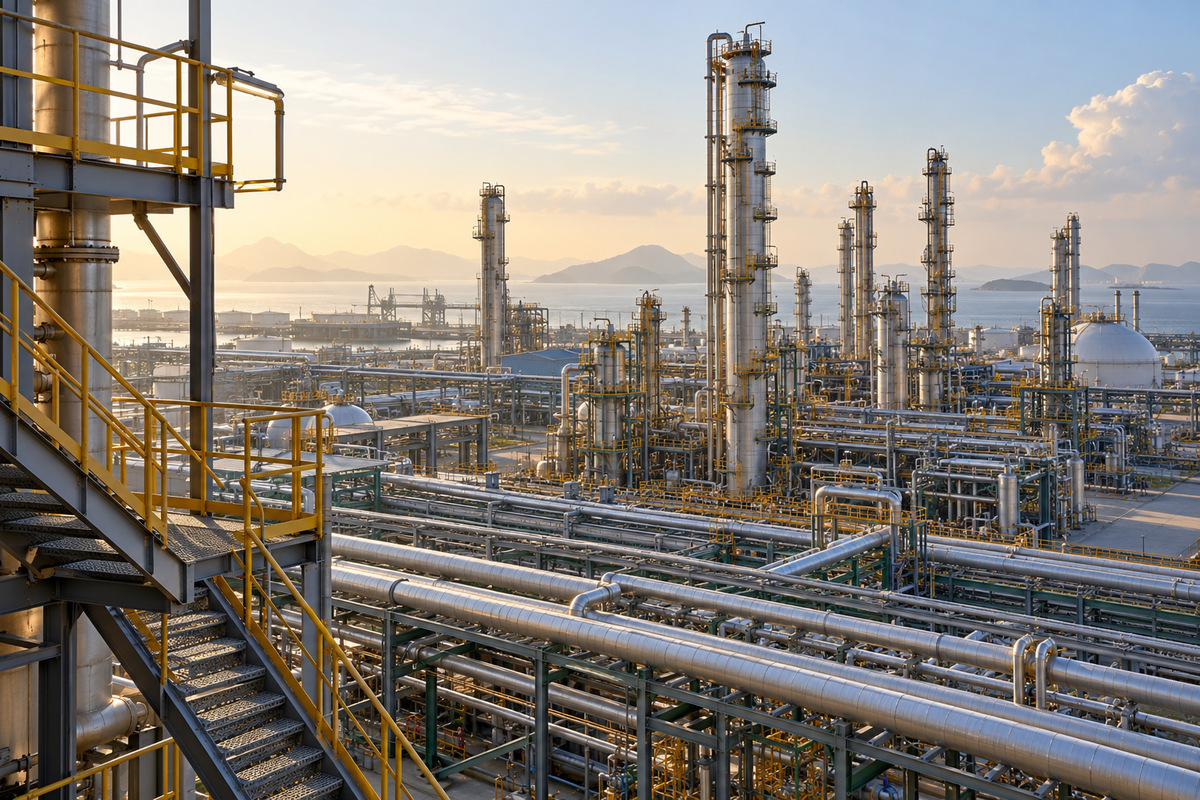
BASF is expanding its manufacturing presence in China through the Zhanjiang chemical complex in Guangdong. Stephan Kothrade, the executive board member responsible for Asia, envisages an operating life of 40–50 years or longer. China accounts for roughly half of global chemical demand and 14% of BASF's revenue; Kothrade expects its revenue share to approach one fifth by 2030. Ahead of the planned Mar 26, 2026 opening ceremony, BASF retained a target of €1–1.2 billion in site earnings by 2030. Kothrade expected production to increase more slowly than originally hoped amid an unfavourable supply-demand balance. Project costs were estimated at approximately €9 billion, with completion envisaged by 2028. BASF's 2025 operating profit had fallen almost 10%, and the company anticipated slower global manufacturing growth in 2026.
Establishing the project in 2019
BASF and Guangdong's provincial government signed a framework agreement in January 2019, following their July 2018 memorandum of understanding. Zhanjiang became the selected location for BASF's second Verbund site in China. The initial agreement envisaged allocating around nine square kilometres of land and investing up to US$10 billion in phases. Its proposed steam cracker had an ethylene capacity of one million metric tons annually, alongside plants making consumer-oriented chemicals. The location offered a deep-water port and transport connections in southwestern Guangdong. BASF already operated six Verbund sites worldwide. Its existing Asian sites had different ownership arrangements: Nanjing was a 50:50 joint venture with Sinopec, while Kuantan was a 60:40 partnership with Petronas. Zhanjiang was planned under BASF's sole responsibility, with production linked through shared infrastructure, raw materials and energy.
A liaison office opened in Chikan District, central Zhanjiang, in March 2019. BASF equipped it with materials and systems from its own portfolio, including carpeting, low-VOC wall coatings, filtered drinking water, thermal and acoustic insulation, and LED lighting with a daylight-like colour profile. The office established a local base for implementing the production project and working with customers. BASF also intended to engage local stakeholders on employment and community development. The underlying Verbund model linked neighbouring production units: waste heat could supply energy elsewhere, while one plant's by-products could become another's feedstocks. Sanjeev Gandhi, then BASF's board member responsible for Asia Pacific, envisaged the site supporting higher-value manufacturing for customers in southern China. Planned customer industries ranged from automotive and construction to food packaging, home care and personal care.
BASF formally launched the Zhanjiang project in November 2019. The first plants were intended to make engineering plastics and thermoplastic polyurethane, or TPU, for southern China and other Asian markets. Automotive manufacturing, electronics and new-energy vehicles were among the intended applications. Automated packaging, advanced control systems and automated guided vehicles formed part of the proposed smart-manufacturing concept. BASF was establishing partnerships with local technical institutions to develop young technical staff. A newly formed wholly owned subsidiary, BASF Integrated Site (Guangdong) Co. Ltd., would oversee site operations. Kothrade, then responsible for Asia Pacific functions and Greater China, envisaged stronger business connections between South China and other Asian countries. The project connected basic chemical production upstream with plants supplying more consumer-oriented products downstream.

Electricity and the initial production phase
BASF proposed Renewable Direct Power Purchase at the end of 2019, working with China Resources Power on Guangdong's electricity-market policy before its first factories opened. On Feb 26, 2021, the Guangdong Development and Reform Commission issued the Pilot Implementation Plan of the Province's Renewable Electricity Consumption Guarantee. Guangdong Power Exchange Center was to develop trading rules under that framework. In March 2021, BASF intended to purchase renewable electricity for the first engineering-plastics and TPU plants and expected to become the first purchaser under the new rules. Klaus Welsch, then president of Mega Projects Asia, envisaged extending renewable procurement across the site. The announcement concerned a purchasing mechanism and planned electricity supply for manufacturing; its carbon-reduction ambitions remained company objectives.
BASF gave final construction approval on Jul 19, 2022. The decision moved the project into construction of the core Verbund facilities, comprising a steam cracker and downstream petrochemical and intermediate plants. BASF's investment envelope at that point was up to €10 billion by 2030, with the site to be developed in several phases and fully operational by that year. The engineering-plastics plant was starting up, and the TPU plant was expected to follow in 2023. Those milestones formed the construction programme announced at approval, with separate manufacturing units opening progressively.
The first plant's inauguration followed in September 2022. BASF assigned the engineering-plastics compounding facility an annual capacity of 60,000 metric tons for Chinese customers, particularly automotive and electronics manufacturers. Its addition was expected to take BASF's engineering-plastics capacity in Asia Pacific to 420,000 metric tons from 2023. BASF planned to supply the plant entirely with renewable electricity. Martin Brudermüller, then chairman of the executive board, regarded the inauguration as the beginning of the larger site, which he expected to become BASF's third-largest Verbund location worldwide. BASF also retained a site-wide renewable-electricity objective for 2025. The first plant's opening introduced one manufacturing unit within that phased programme.
A neopentyl glycol investment followed in October 2022. BASF planned an 80,000-metric-ton annual NPG plant at Zhanjiang, with startup targeted for the fourth quarter of 2025. The addition would raise its global NPG capacity from 255,000 to 335,000 metric tons annually. Existing NPG production locations included Ludwigshafen, Freeport in Texas, Nanjing and Jilin. NPG is an intermediate used mainly in powder-coating resins, including coatings for buildings and household appliances; lubricants and plasticizers provide other applications. Vasilios Galanos, then senior vice president of Intermediates Asia Pacific, identified Chinese powder coatings as a particular area of customer demand. Anup Pandey, responsible for acids and polyalcohols business management in the region, expected the plant to support that market. The stated capacity and commissioning quarter were investment plans.
Building downstream chemical capabilities
On Mar 7, 2023, BASF announced investment in a citral plant at Zhanjiang alongside downstream menthol and linalool plants in Ludwigshafen, Germany. These facilities were expected to start operating from 2026 onwards. The programme would expand BASF's global citral capacity to 118,000 metric tons per year and diversify an existing production footprint in Germany and Malaysia. The capacity figure applied to BASF's worldwide citral network. Thilo Bischoff, senior vice president of Aroma Ingredients, expected the additional locations to strengthen supply security for flavour and fragrance customers. BASF intended to integrate the new facilities into the respective Verbund networks, using shared resources and production infrastructure. Automation and process technologies at Zhanjiang were intended to reduce energy consumption and emissions, alongside its planned renewable-electricity supply.
The acrylic-acid complex reached its groundbreaking milestone in March 2023. The planned units covered glacial acrylic acid, butyl acrylate and 2-ethylhexyl acrylate, commonly abbreviated as GAA, BA and 2-EHA. BASF specified annual capacities of approximately 400,000 metric tons for BA and 100,000 metric tons for 2-EHA, with operation then scheduled for 2025. Hartwig Michels, president of Petrochemicals, expected the facilities to serve Chinese and wider Asian demand, including hygiene products and coatings. Haibo Tian, responsible for Industrial Petrochemicals Asia Pacific, envisaged shorter customer lead times through regional production. The products have different manufacturing applications:
- Acrylic acid: a precursor for superabsorbent polymers.
- BA: adhesives and architectural or industrial coatings.
- 2-EHA: adhesive and coating applications.

Polyethylene construction began with a separate groundbreaking announced on Jun 19, 2023. BASF planned annual PE capacity of 500,000 metric tons, with startup scheduled for 2025. Bir Darbar Mehta, senior vice president of Petrochemicals Asia Pacific, expected Chinese demand to grow faster than demand elsewhere and identified consumer goods, packaging, construction and transport as customer sectors. Bejoy Chandran, responsible for basic business and China sales management, highlighted durable applications such as pipes, specialty films and blow-moulded parts for household and industrial chemical containers. Polyethylene is produced from ethylene and is used in products ranging from heavy-duty storage tanks and pipelines to flexible packaging. BASF intended to integrate PE manufacturing into the site's upstream chemical supply, with particular emphasis on customers in southern China.
BASF announced construction of a syngas plant on Sep 4, 2023, with operation scheduled for 2025. Its planned outputs were syngas and hydrogen for use inside the Verbund network. The principal feedstocks were carbon-dioxide off-gas from ethylene-oxide production and excess fuel gas from the steam cracker. The equipment could also use additional feedstocks, giving the plant flexibility in its raw-material supply. Bir Darbar Mehta described the technical concept as the first of its kind in China and expected it to reduce direct carbon emissions compared with other technologies, particularly for oxo and ethylene-oxide products. BASF intended to connect the plant to a site-wide electricity grid powered entirely by renewables by 2025. These were the process concept and environmental objectives attached to its construction announcement.

Materials, customers and construction progress
The TPU plant was inaugurated on Jan 18, 2024, concluding the initial construction phase. BASF identified it as its largest single TPU production line worldwide. Automated guided vehicles and advanced automation systems formed part of the factory's equipment. Martin Jung, president of Performance Materials, expected the additional Elastollan TPU supply to serve industrial applications, electric mobility and new energy in Asia Pacific. The material's applications include footwear, sports goods, consumer electronics, automotive parts and industrial cable sheaths. BASF highlighted flexibility and long-term durability for electric-mobility cable sheathing. Its regional research network also provided engineering, simulation and manufacturing expertise for customer product development. Haryono Lim, president of Mega Projects Asia, stated that construction attention was shifting to the central steam cracker and other petrochemical and intermediate plants.
Customer preparations advanced alongside factory construction. BASF and Youyi Group signed a letter of intent on Apr 22, 2024, announced two days later. It concerned supplying BA and 2-EHA from Zhanjiang for the Chinese adhesive-materials industry. Youyi made BOPP tape and was expanding into specialty tape, with several Chinese production bases and a new Guangdong factory under construction for BOPP films and tapes. Haibo Tian called the letter the first customer agreement for acrylates from the Zhanjiang site. Lin Ke Bo, Youyi's vice president, identified a partnership with BASF extending over 30 years and expected the arrangement to support further expansion in southern China. At signing, both Youyi's new facility and BASF's acrylic complex were preparing for production startups scheduled for 2025.

BASF introduced the Easiplas HDPE brand on Nov 29, 2024, while reporting installation of major equipment at its polyethylene plant. The name combined references to ease of use, ethylene and plastics. BASF intended to accompany the product range with technical support from industry specialists. Xu Yang, HDPE business management director for Petrochemicals Asia Pacific, identified consumer goods, packaging, construction and transport as intended markets. The construction team had lifted and installed a reactor and product purge bin, advancing towards mechanical completion. Hui Feng, vice president of Basic Petrochemicals Operations in the region, still expected startup at the end of 2025. The plant's announced capacity remained 500,000 metric tons annually. The equipment installation and brand launch were preparations for that manufacturing programme.
By Jul 21, 2025, the first batch of acrylic-complex plants had reached mechanical completion. This milestone included the GAA and BA units. BASF was moving into commissioning and startup, with operations still expected during 2025. Han Liang, vice president of Industrial Petrochemicals Operations for Petrochemicals Asia Pacific, described the construction team's work since groundbreaking in 2023 and expressed confidence in the planned startup. Bir Darbar Mehta expected the additional facilities to supply competitive acrylic products with shorter lead times to Chinese and other Asian customers. Mechanical completion represented the construction stage preceding the commissioning work then beginning.

First products and the steam cracker
BASF began making the first products from the core Verbund facilities by Nov 5, 2025. Several downstream plants were operating, while the entire central network was expected to be ready for startup by the end of that year. Markus Kamieth, chairman of the executive board, envisaged the new production supporting BASF's local manufacturing approach and strengthening its core businesses over the medium and longer term. Kothrade linked the investment to proximity to regional customers. BASF's November announcement also retained the capital-spending forecast presented at its October 2025 Capital Market Update: approximately €8.7 billion, with construction described as on schedule and below budget. That forecast accompanied the partial production milestone. The steam cracker and downstream plants belonged to the main construction phase approved in July 2022.
BASF announced successful commissioning of the Zhanjiang steam cracker on Jan 7, 2026. The cracker supplies ethylene and propylene to other site plants. Its process uses steam to crack long-chain hydrocarbons, including naphtha or butane, into basic chemicals that enter downstream manufacturing chains. BASF specified ethylene capacity of one million metric tons per year. The company identified the main-compressor electric drives as powered entirely by renewable energy and described the installation as the first cracker worldwide to use that arrangement. It also announced that ethylene-oxide, ethylene-glycol and polyethylene plants had entered operation after the startup of several propylene downstream units. The annual ethylene figure denotes installed production capacity. BASF intended the site's products primarily for customers in China.

Leave a comment